A debate is spreading across India. The Cockroach students movement recently succeeded within a few days at forcing change that traditional political parties have failed to achieve in years. The Cockroach Janata Party (CJP), a mere social media campaign started by Abhijit Dipke, is credited with pressuring the Central government enough to remove Dharmendra Pradhan as Union Education Minister and raising hopes for wider education reforms. Its central message is that someone must be held accountable for every action. That model is now being followed by other campaigns.
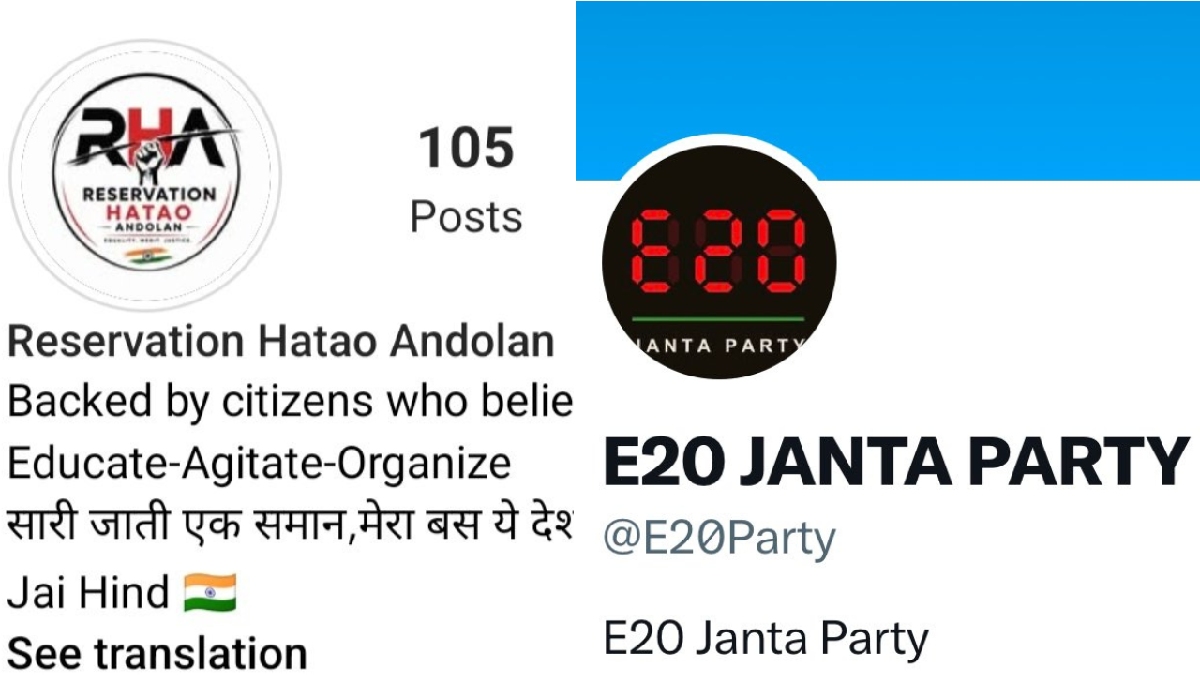
Many transport associations and private car owners of Delhi are opposing the blending of ethanol with petrol and have called for a large protest march to Parliament House on 4 August, demanding pure petrol. The campaign has spawned an “E-20 Janata Party” on Instagram, whose followers have topped 277,000 in a short span of time. Supporters opine that the exit of Dharmendra Pradhan should be followed by Nitin Gadkari, the Minister of Road Transport and Highways, as the next target of public pressure.
Also Read


However, it may be noted that decisions on ethanol blending fall under the purview of the Ministry of Petroleum and Natural Gas, under Minister Hardeep Singh Puri, connected to the infamous Epstein files. Separately, a campaign to end reservations in India is gaining momentum. An Instagram page called Anti-Reservation Janata Party has drawn more than 4.5 million followers. The page is campaigning against caste-based reservations and is being framed by supporters as a parallel protest movement to the student-led agitation. Uniting Hindoo society is a core goal of the Rashtriya Swayamsevak Sangh (RSS).
But the organisation, which draws heavily on Brahmanical ideology, may also aim to dismantle government mechanisms such as caste-based reservations in education and employment. Reconciling these two contradictory objectives could prove a difficult task. If reservations were eliminated, upper-caste support would likely consolidate behind the Bharatiya Janata Party (BJP).
However, that move risks alienating Dalit and tribal voters, who could shift away from the BJP as a result. In India’s current political climate, any party that moves against reservations faces a near-certain electoral setback. The push to build an anti-reservation platform may be an attempt to blunt the popular Gen Z protests observed at Jantar Mantar and also in many other places across the nation. Whether that strategy to blunt it succeeds or not remains to be seen. During those protests, students used harsh language to mock and criticize ruling party leaders — remarks that appeared to wound leaders accustomed to viewing themselves as lords of the ring. Despite the expletive-filled criticism directed at them, this educated generation represents the country’s future also. These young people, without doubt, will soon hold decision-making power in India. Efforts to divide this young generation of voters by stoking anti-reservation sentiments appear unlikely to succeed. Many believe social balance will ultimately emerge from this rising generation — and if it does, the reservation system may fade away on its own. Discussions over education system reforms brought unexpected unity across the board.
On the issue of ethanol blending, owners of vehicles ranging from two-wheelers to 20-wheelers are likely to find similar common ground for unity. If a few more such issues emerge, the country could see astounding unity at national level. This new style of solidarity is surely undermining an older mindset — one that depends on division to survive. Meanwhile, let us not forget that the current government is pushing hard for Delimitation to expand the number of seats for elected representatives, supposedly with a lofty goal to accommodate more women representatives through reservation. Splitting the population into smaller groups scattered across the country, by whatever means, makes those groups easier to control.
Divisions such as Hindoo-Moslem, Hindoo-other Minorities, Vegetarian-Non vegetarian, Upper-Lower castes, Hindi-Non Hindi speakers and more such groups make the playground more comfortable for some. That may explain why opposition to reservation policies has resurfaced at this particular moment. The movement itself seems to be an effort to divide society at this juncture at which the youth of India is getting united.