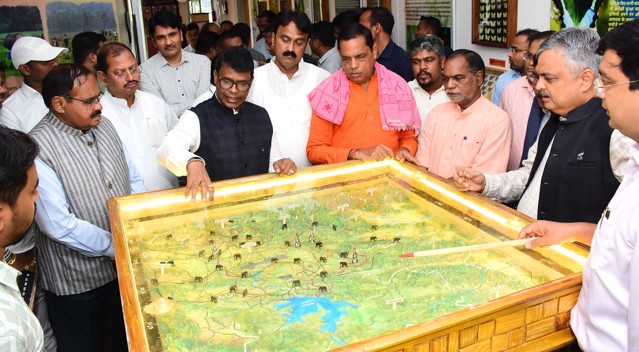
Bhubaneswar: Forest, Environment and Climate Change Minister Ganesh Ram Singkhuntia Wednesday said a science-based, technology-enabled and community-centric approach would go a long way towards tackling human– elephant conflict, stressing that human safety and elephant protection must go hand in hand.
Addressing the state-level World Elephant Day programme organised by the Forest Department’s wildlife wing and the Regional Museum of Natural History, Singkhuntia outlined a series of measures by the state government focusing on safer electrical infrastructure, protection of elephant corridors, habitat improvement, community participation and the welfare of frontline conservation workers.


“A science-based, technology-enabled and community-centric approach would go a long way towards tackling human– elephant conflict,” Singkhuntia said, stressing that “safety of humans and protection of elephants must go hand in hand”.
Official sources said that between 2020 and 2026, as many as 906 people and 513 elephants lost their lives in human–elephant conflict, making conflict mitigation a key priority for the state.
The synchronised elephant census conducted in 2024 estimated 2,098 elephants during summer and 2,103 during winter, indicating a relatively stable elephant population in the state.
However, scientific assessments suggest that Odisha’s forests have an ecological carrying capacity of only around 1,700–1,800 elephants, they said.
This has prompted a management approach focused not simply on increasing elephant numbers but on maintaining populations within ecological limits while ensuring adequate habitat and movement corridors.
Three notified elephant reserves — Mayurbhanj, Mahanadi and Sambalpur — remain the state’s principal conservation landscapes.
The state has also identified 11 major elephant corridors to facilitate seasonal movement, genetic exchange and connectivity between fragmented habitats.
Protecting these corridors has become increasingly important as habitat fragmentation and human settlements create greater opportunities for elephants to come into conflict with people.
Electrocution has emerged as the leading preventable cause of elephant mortality, prompting increased focus on electrical safety.
The government is undertaking infrastructure upgrades in elephant-prone areas and strengthening mechanisms to identify and address hazardous power installations, they said, adding that the state is also deploying Bidyut Prahari teams and Rapid Response Teams as part of its conflict-mitigation strategy, while awareness programmes are being conducted in communities vulnerable to elephant movement.
Community participation is another key pillar of Odisha’s conservation strategy. More than 2,100 Gaja Sathis have been engaged to support communities, assist in conflict mitigation and coordinate with forest personnel.
Their role is particularly important in areas where elephants frequently move through human settlements and agricultural landscapes.
Recognising the risks faced by these frontline workers, the government is exploring accidental death insurance coverage for Gaja Sathis.
The proposed social-security package is expected to cover accidental death, disability, hospitalisation, children’s education, daily hospital allowance and family transportation at a minimal annual premium.
The initiative is aimed at strengthening the economic and social security of Gaja Sathis and mahouts, who remain closely involved in elephant management and human–elephant coexistence.
The state is also focusing on improving habitat quality so elephants have better access to food and water within forests.
Measures include bamboo and fruit-bearing plantations, artificial water bodies and soil-moisture conservation works.