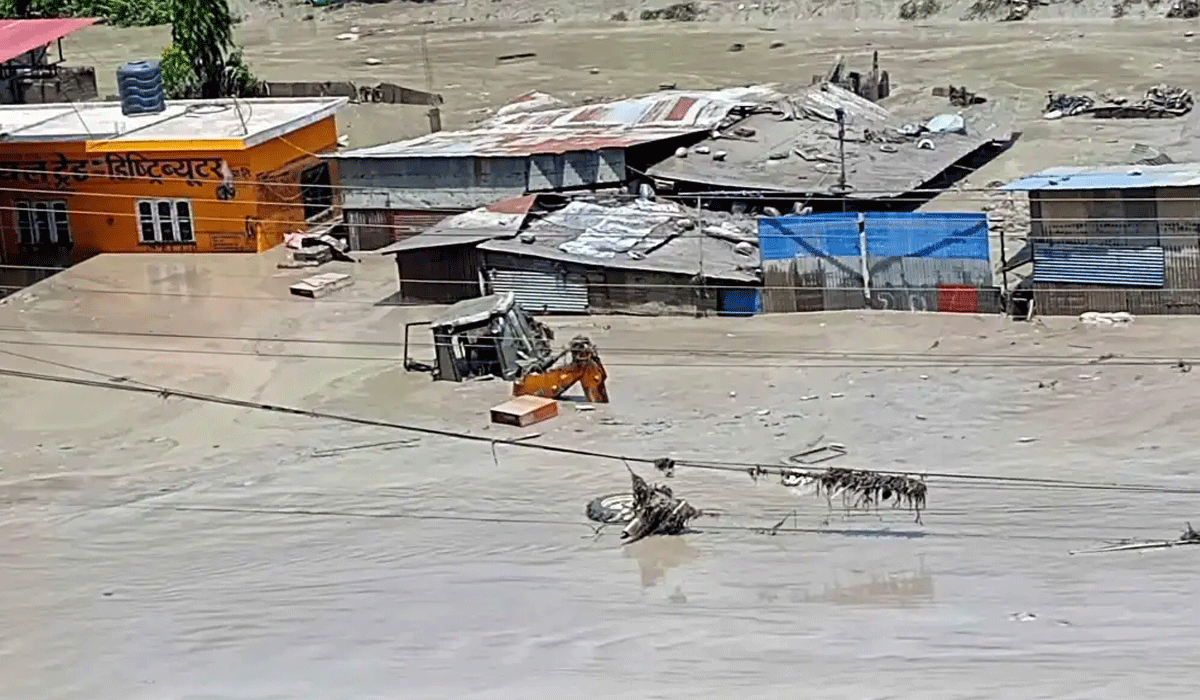
Climate justice should become one of the most important points when discussing climate change. The harsh reality of human-induced climate disasters is that nations which have the lowest carbon footprint and have had the least contribution to the crisis are oftentimes ones that bear the maximum brunt. The most recent case is the catastrophic flash floods in Nepal near the Tibetan border that have claimed 768 lives as of now with thousands more missing. The numbers continue to rise. The collapse of a glacier near Langtang Lirung peak on the Nepal-Tibet border turned into a terrifying fury of ice, rock, mud and water that swept through valleys, towns, villages, roads, bridges and vital infrastructure, destroying everything in its path.
Rising global temperatures are accelerating glacier melt, destabilising ice and rock, and altering the freeze-thaw cycles that help hold enormous mountain slopes together. The Himalayas have faced decades of abuse in the form of hydroelectric power projects, dams, roads, tunnels and even adventure and religious tourism on a massive scale in recent years, ignoring all warnings and good sense. Scientists have warned that such conditions can make high-altitude ice and rock formations increasingly susceptible to sudden collapse, creating cascading disasters of precisely the kind Nepal has witnessed. The disaster also demonstrates how such catastrophes obviously transcend geopolitical boundaries. The surge from the Lhende Khola river entered the Bhotekoshi and Trishuli river systems, altering river channels far downstream towards the Indian border.
Also Read


The disaster raises a pertinent question about the relentless construction of infrastructure in the Himalayan region, particularly on the Chinese side of the border. China’s aggressive infrastructure push across Tibet is no longer merely a matter of roads and economic development. In a highly eco-sensitive region already destabilised by accelerating climate change, extensive large-scale construction in the Himalayan region is creating an urgent environmental and geopolitical risk for countries downstream. The most consequential project is the Yarlung Tsangpo hydropower cascade, including the massive project planned in Tibet’s lower reaches. The river enters India as the Siang and Brahmaputra before flowing into Bangladesh. The project involves five massive hydropower stations and is expected to become the world’s largest power facility, topping China’s mammoth Three Gorges Dam. Alongside dams, China has been rapidly expanding roads, bridges, tunnels, border infrastructure, power facilities and settlements across the Tibetan plateau, an extraordinarily fragile and earthquake-prone landscape.
At the same time, hydropower and road construction activities have also expanded rapidly in valleys in Nepal that are naturally prone to landslides, floods and seismic activity. Reports indicate that hundreds of hydropower workers are among those missing in the flash floods.
Likewise, India’s Himalayan states are also pursuing an infrastructure drive that increasingly collides with the ecological limits of the mountains. Relentless construction activities in states like Uttarakhand, Himachal Pradesh and Sikkim have turned the delicate ecosystem into a ticking time bomb. The Char Dham project in Uttarakhand, involving the widening of hundreds of kilometres of highways to Yamunotri, Gangotri, Kedarnath and Badrinath, has already raised concerns over hill cutting, forest loss, muck disposal and landslide vulnerability. A Supreme Court-appointed committee had highlighted the cumulative ecological risks of the project. Similarly, expanding highways, tunnels and hydropower projects in Himachal Pradesh, Sikkim and Arunachal Pradesh are adding pressure to a seismically active landscape. In Sikkim, the Teesta hydropower system suffered devastating damage during the 2023 South Lhonak glacial lake outburst flood. Nevertheless, reconstruction of Teesta Stage III is now proceeding.
The danger lies in completely ignoring the risks that come with destabilising the world’s tallest mountain range beyond the point of return. With climate change increasing glacier instability and frequent extreme weather events, the Himalayas cannot be treated as an unlimited resource and continuous construction zone. Roads, dams and tunnels must be subjected to rigorous cumulative environmental and disaster-risk assessments before the next catastrophe makes the cost of development impossible to ignore. Additionally, information on projects must be openly shared with relevant neighbouring nations and risks assessed with them since those nations will face the brunt of human-created natural disasters downstream.
The Himalayas have amply indicated that human activities have come to a dangerous tipping point. Ignoring these warnings will pave the way for catastrophes whose scale might be impossible to ignore in future. Unfortunately, smaller countries like Nepal will pay a heavier price for the unending greed of bigger nations.