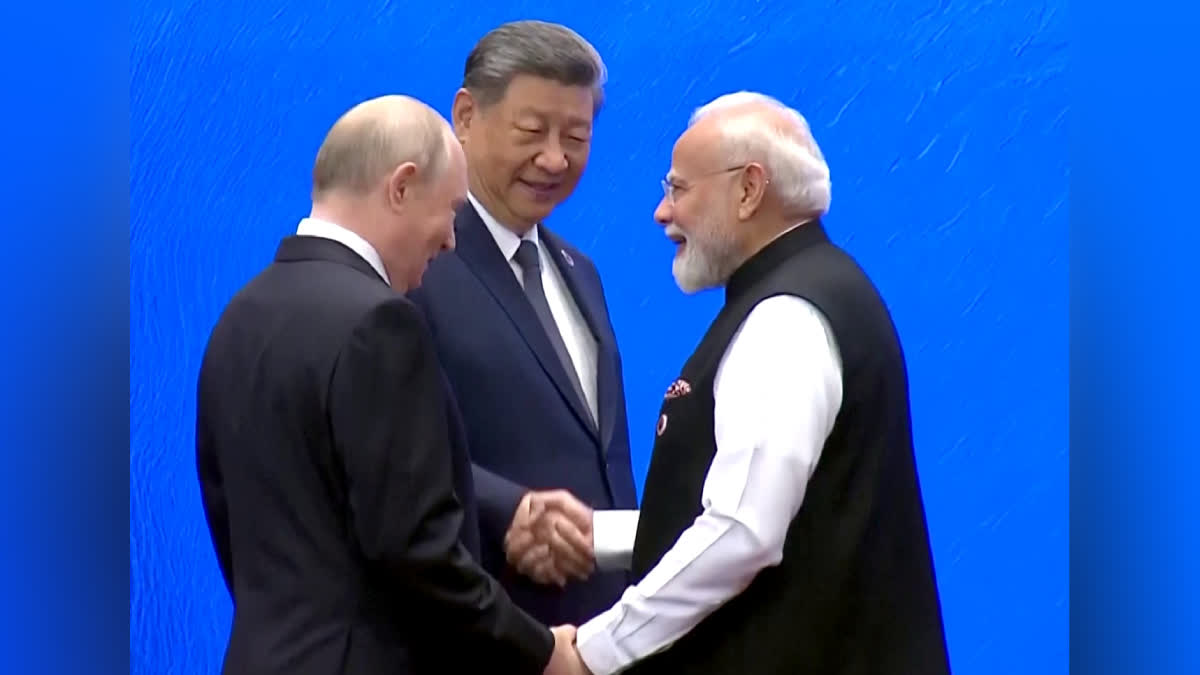
The 26th Council of Heads of State of the Shanghai Cooperation Organisation (SCO) concluded in Bishkek on 1 September, marking 25 years of the grouping. The summit adopted the Bishkek Declaration — signed by Prime Minister Narendra Modi along with Chinese President Xi Jinping, Russian President Vladimir Putin, Iranian President Masoud Pezeshkian and six other members.
The declaration is stark. It expresses “deep concern over developments in the Middle East and around Iran” and condemns “military strikes on the territory of the Islamic Republic of Iran, which has resulted in numerous civilian casualties and significant damage to the country’s economy.” It further states that such actions “violate the principles and norms of international law and the UN Charter and create serious risks to international peace, security and stability” — a clear reference to US-Israel operations. The SCO also backed a comprehensive and just settlement of Palestine, opposed unilateral coercive sanctions, and reaffirmed commitment to a multipolar world order.


For India, this signature sits uneasily. Just days before the Iran war escalated, Modi was in Israel, describing it as the ‘fatherland’ of India in a moment of hyperbolic bonhomie. How do these two statements — condemnation of strikes on Iran at Bishkek and celebration of Israel in Tel Aviv — sit together? That contradiction is at the heart of India’s current foreign policy dilemma. Understandably, heads of governments make hyperbolic statements in countries they visit. Diplomatic posturing, courtesies, the desire to please a host — all are part of statecraft.
But this is lot more than that. India-Israel ties have gone too deep to break. Defence, technology, agriculture, intelligence, diaspora — the relationship is strategic, not ceremonial. At the same time, India is part of a grouping whose members, except Pakistan which has mastered double standards, have no sympathy for US policies. The Bishkek Declaration is explicitly aimed at challenging America’s hegemony and unilateral action, endorsing Iran’s rights, and calling out sanctions.
India has been known for taking a moral, neutral and institutional position on global issues — non-alignment, Panchsheel, strategic autonomy with a conscience. That tradition appears to have been billed, for the time being. The other aspect of India’s foreign policy today is pursuing multi-alignment in a multipolar world. That may explain Modi’s desire to be in both camps — in Bishkek condemning strikes on Iran, and in Tel Aviv endorsing Israel’s right to self-defence; buying oil from Russia while buying arms from America; joining the Quad and also signing the Bishkek Declaration. I have two reactions to this.
One, a few strategic countries bordering big powers or in conflict with them have chosen their sides clearly. Take Sweden and Finland. For decades they practised ‘Finlandisation’ — forced neutrality to accommodate Soviet sensitivities. When that became untenable after Russia’s invasion of Ukraine, they chose — they joined NATO to defend their territorial integrity. Neutrality has a shelf life when security is at stake. In SCO, all members except India are part of the camp opposed to the West. It is US President Donald Trump’s inexplicable strategy that propped up Pakistan as a peace-broker in the Iran war, further complicating India’s position.
Second, we should remember the dictum, “everybody’s friend is no one’s friend.” Multi-alignment cannot mean permanent ambiguity. At some point, credibility requires consistency. My contention is that a country like India, which seeks to take an ethical position in world affairs, should build and preserve its credibility. India’s image as a democracy, an inclusive and liberal society, a responsible power that speaks international law, should be nurtured. That moral capital took decades to build.
The overriding objective at Bishkek was to promote the concept of a multipolar world and mutual trade as against Trump’s unilateral policies. The deliberations focused on condemning attacks and sanctions on Iran and attacks on Palestine, but also on concrete steps — 28 documents were signed, including regulations for a new Universal Center for Countering Threats, an action plan for ports and logistics centers through 2030, a Green Technology Corridor, and crucially, statements on nuclear security and energy cooperation. With Iran as a full member and Russia and China present, the energy cooperation statement carries direct implications for US efforts to squeeze Iranian oil revenues.
The declaration also recalled the non-aligned nature of the organisation, while simultaneously pushing for an SCO Development Bank to facilitate local-currency trade settlements — a clear de-dollarisation push.
For India, which in June 2025 had refused to endorse an SCO statement condemning Israel for its attack on Iran, signing this time is a shift. In Bishkek, Modi also met Pezeshkian for the first time in two years, discussing regional stability and seafarers — a small signal that New Delhi wants to keep a channel open. New Delhi may be hoping that declarations in summits are diplomatic rituals — words that do not bind. One wished it were true. In today’s world, declarations are read in Washington, Tel Aviv and Brussels as alignment. India should choose right partners which will contribute to peace, growth and security of our country.
India cannot straddle two horses for long — one galloping towards Washington-Tel Aviv, the other towards Beijing-Moscow-Tehran. Multi-alignment must have a hierarchy. India’s core is with democracies, with international law, with freedom of navigation. Bishkek Declaration’s language on international law is fine; its geopolitical anti-West slant is not India’s natural home.
The Bishkek summit will be remembered for 25 years of SCO, but also for India’s awkward straddle. In a world where everybody wants India to choose, saying “we are everybody’s friend” may soon mean we are nobody’s reliable partner. Credibility, like trust, is hard to earn and easy to lose.
The writer is Professor of Practice, Institute of Management Bhubaneswar. ©INFA