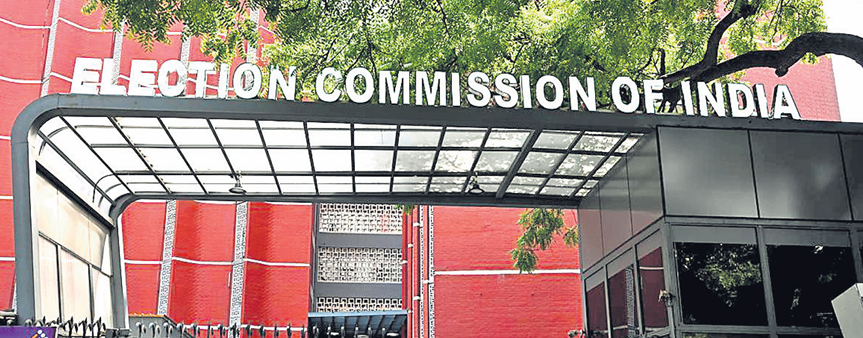
Delhi’s streets have filled with slogans, marches and ultimatums demanding the resignation of the Chief Election Commissioner.
The script is familiar: the Election Commission was a temple of independence until yesterday, and a wicked government has just desecrated it. It is a moving story. It is also a fiction, and those telling it know better.


Proof? Show it.
Begin with what the protesters cannot produce: a finding. The Supreme Court, hearing the pleas on the SIR, declined to pass any interim order sus pending the CEC. It issued notice and asked the Commission to respond.
That is all. The Commission rejects the claim that reported objections amount to institutional dissent. A demand for resignation before a single adverse finding is not a legal argument. It is a rally dressed as a verdict.
Seventy years of “government-appointed”
Article 324 left appointments to the President acting on the government’s advice. Parliament passed no law on the process for more than seventy years, and for most of those decades the Congress governed.
Every Commissioner who served in all that time was the government’s pick. The party that now thunders about capture sat comfortably inside that arrangement for most of its life, and never once felt the urge to fix it.
1989: Crowding the umpire
In October 1989, a month before the general election, Rajiv Gandhi’s government suddenly created two Election Commissioner posts and filled them with SS Dhanoa and VS Seigell.
This was widely seen as an attempt to rein in the then CEC, RVS Peri Sastri, with whom the government had fallen out. When the Congress lost the election, the new government abolished both posts within weeks.
A ruling party facing an umpire it did not trust expanded the Commission and left the rest to the voters. That was Congress’s idea of institutional independence.
1993: When Seshan became inconvenient
TN Seshan was no ordinary Commissioner, and his lashings of the political class made him unpopular in the highest circles.
The Narasimha Rao government’s reply, in October 1993, was to appoint two more Commissioners, MS Gill and GVG Krishnamurthy. Seshan objected, arguing that it diluted the authority of the Chief Election Commissioner.
No one needs to pretend the motive was admiration for his work.
The Chawla affair
In 2006, LK Advani and more than 200 MPs pe titioned President Kalam to remove Navin Chawla as Election Commissioner for alleged partisanship. The Shah Commission, which examined Emergency excesses, had already made harsh observations about him.
In January 2009, the sitting CEC, N Gopalaswami, sent the President a detailed report recommending Chawla’s removal, citing instances of what he called a lack of political neutrality. The UPA government rejected that recommendation outright.
Then, in April 2009, weeks before a general election, the government made Navin Chawla the Chief Election Commissioner. Pause on that. A sitting CEC had formally concluded that a colleague should go.
The government of the day looked at that report and responded with a promotion. Chawla denied every charge and none was judicially established, but the sequence speaks for itself. The very people who now invoke the sanctity of the chair showed, when it mattered, how much it was worth to them.
Chawla himself later recommended that Election Commissioners be given the same removal protection as the CEC. Parliament never acted. The Congress that held power for decades had every chance to give the Commission that shield, and did not.
The Seshan sequel
Seshan proved that a government-appointed Commissioner could be fearless, and the credit is his. What followed deserves a footnote that the party of outrage would prefer to skip.
Af ter retirement he contested the 1997 presidential election and lost heavily to KR Narayanan, backed in that attempt by the Shiv Sena. In 1999 he accepted a Congress ticket to take on Ad vani in Gandhinagar, and lost by a wide margin.
His choices were his own, and he was entitled to them. But it is a revealing detail about how easily the line between the Commission and the campaign trail has been crossed, and how readily the party now shouting about neutrality embraced a former referee when he came wearing its colours.
What this government actually changed
Parliament legislated in 2023, and the Chief Election Commissioner and Election Commissioners Act created a selection committee of the Prime Minister, a Union Cabinet Minister and the Leader of the Opposition.
A search committee headed by the Law Minister prepares the panel of names. This is the first time the appointment of Election Commissioners has been placed on a statutory footing, after seven decades in which it rested on executive discretion alone.
For the first time in India’s history, the Leader of the Opposition has a statutory seat where Election Commissioners are chosen.
Under the Congress, for most of seven decades, the Opposition had no say at all: the government chose, and the country was expected to trust.
Parliament has now done what the Supreme Court itself invited it to do, and it has given the Opposition a voice that the Congress never did. Those who call this capture should explain why they never offered such a seat when they held the pen.
The SIR, minus the theatre
Revising the rolls is a constitutional duty of the Commission. Whether eligible citizens were wrongly excluded and whether the process is trans parent are questions of fact.
They are for evidence, audits and the Supreme Court, which is already seized of the matter. No amount of shouting outside the Election Commission office will substitute for any of it.
One revision, two verdicts
The same SIR exercise ran across Kerala, West Bengal, Tamil Nadu and Assam before this year’s assembly polls.
In Kerala the Congress-led UDF won decisively, and the Congress did not say a word about the rolls. In West Bengal and Assam it lost, and Rahul Gandhi alleged that the elections were manipulated.
If an exercise is flawed only in the states where the Opposition loses and flawless where it wins, the objection is to the result and not to the process. Those who lost the argument at the ballot box now seek to win it on the streets, demanding a constitutional functionary’s head by pressure when the Constitution lays down how a Chief Election Commissioner may be removed: a motion in Parliament with a two-thirds majority.
A mandate given by voters is not undone by marches, and those who campaign to delegitimise it, whatever they call it, should say plainly what they want next.
A challenge to the critics
If the Opposition truly wants an independent Commission, let it say so by agreeing to equal removal protection for all Commissioners, as Chawla himself proposed, to recorded deliberations among the three Commissioners, and to published, independently audited electoral rolls.
Let it explain why none of this was done in the decades it ruled. Institutions are not defended by selective memory.
A party that crowded the umpire in 1989, diluted him in 1993, shielded and promoted a challenged Commissioner in 2009, and recruited a former one in 1999 has no standing to lecture anyone on the Commission’s honour. Democracy deserves better than outrage with amnesia.
The writer is the Chief Minister of Odisha.