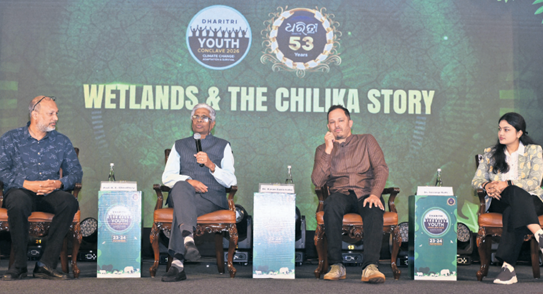
Bhubaneswar: The second panel discussion, ‘Wetlands & The Chilika Story’, explored the ecological significance of Chilika Lake, marine biodiversity and the need to balance conservation with local livelihoods.
Moderated by Kartik Shanker, founder-trustee of Dakshin Foundation, the session featured wildlife biologist BC Choudhury, marine conservation scientist Aaron Savio Lobo and OUAT Assistant Professor of Agricultural Economics Suvangi Rath.
Choudhury described his participation as a homecoming, recalling childhood visits to Chilika.
Pointing out that civilisations had historically flourished along riverbanks, he said people often failed to care adequately for these natural ecosystems.
He called for the protection of Chilika and urged that Odisha’s coastline be recognised as a global heritage site for its rich biodiversity.
Lobo shared his research experiences along Odisha’s coast, recalling how his initial visits to Paradip to study sea snakes exposed him to the large-scale mortality of marine species, including non-target fish caught as bycatch and discarded.
The experience prompted him to focus on marine biodiversity and conservation.
Highlighting Odisha’s ecological wealth, he cited the Olive Ridley mass-nesting beach at Rushikulya, Chilika’s Irrawaddy dolphins and the crocodile-rich mangroves of Bhitar Kanika.
He stressed the need for collaborative conservation efforts involving communities and organisations.
Rath called for a broader assessment of Chilika’s economic significance, arguing that research often focused on fishers’ income while overlooking ecological losses and the environmental services provided by the lagoon.
She advocated assigning economic value to biodiversity and ecosystem degradation while promoting sustainable fishing practices to protect both the lagoon and fishing communities.