By Arindam Ganguly, OP
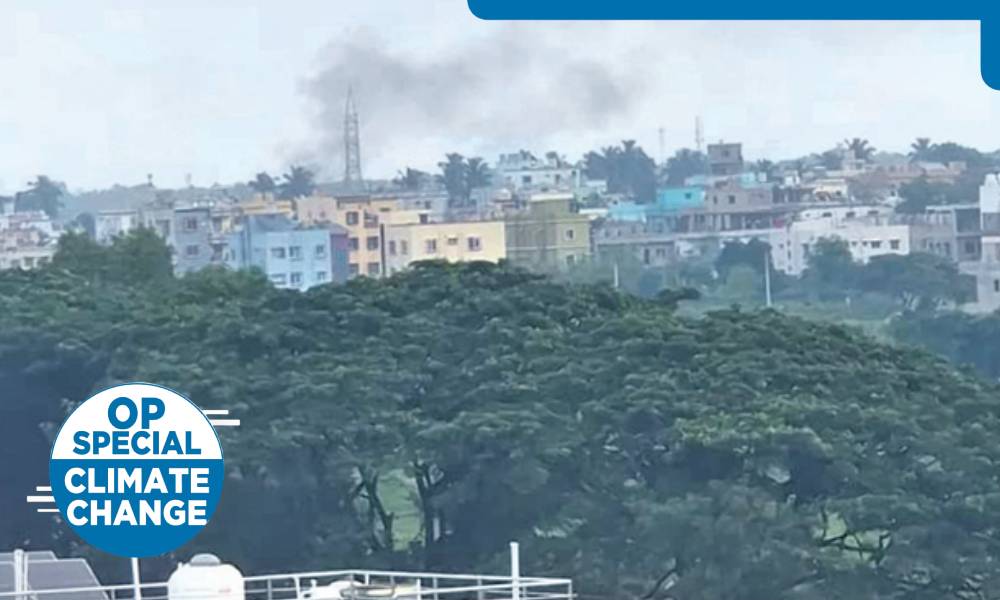
Bhubaneswar: A city once celebrated for its greenery, wide roads and relatively clean environment is gradually losing one of its most precious assets — clean air. In Bhubaneswar, pollution is no longer merely a seasonal concern or a brief spike during Diwali; it is becoming an everyday reality, visible in dust-filled roads, smoke billowing from industrial clusters and debris at construction sites.


While the national capital is witnessing deteriorating air quality ahead of Diwali, Odisha’s capital is also facing growing concerns as winter approaches. Although Bhubaneswar’s pollution levels remain comparatively lower, vehicular emissions, industrial smoke, construction dust and open waste burning are steadily adding to its pollution burden.
During last year’s Diwali, Bhubaneswar’s Air Quality Index (AQI) reportedly touched 354, placing it in the ‘very poor’ category, according to Odisha State Pollution Control Board (OSPCB) data. The city’s current AQI is hovering around 120 and 160, in the ‘moderate to unhealthy’ category. However, winter conditions could further aggravate pollution by trapping pollutants closer to the ground.
For residents, the problem is no longer an abstract environmental concern. It is something they experience every day. Satyajeet Behera, a City resident and guest lecturer at BJB Autonomous College, recalls an incident that heightened his concerns about prolonged exposure to pollution.
Last year, while teaching students near Mancheswar industrial area, he underwent a health checkup at AIIMS, Bhubaneswar. His haemoglobin level was found to be 18.
“The doctor immediately asked me how many cigarettes I smoked every day. I was surprised because I have never smoked. He then asked whether I frequently visited highly polluted areas,” Behera said. He recalled that it was winter and air pollution around his workplace was severe.
The doctor advised him to wear two masks. Behera said his haemoglobin level returned to normal when he underwent another test three/four months later. Now living in Sameigadia, near the same industrial belt, he continues to witness what he describes as alarming pollution.
“Almost every night, I can see industries releasing thick, dark smoke. By morning, black soot settles on walls, windows and even table surfaces. I frequently experience a burning sensation in my eyes and on my face.
People living near industrial areas are exposed to smoke and airborne particles day and night, and the long-term consequences are deeply worrying,” he said.
 Likewise, Santosh Kumar Rout, a cyclist, says rapid urbanisation has also af fected the experience of cycling in the Temple City.
“Every time I pedal through city streets, I breathe in pollution. Dust-filled roads, vehicular emissions, unattended construction debris and unsafe cycling conditions have made every ride more challenging.
What should be a healthy and refreshing experience has increasingly become a battle against polluted air. Bhubaneswar needs cleaner roads, more trees and safer cycling infrastructure,” Rout said.
 Local social activist Narayan Prusty also raised concerns over accumulated sand and dust along National Highway stretches, which gets resuspended as vehicles pass. “Even walking along some stretches has become difficult.
The BMC must ensure regular road cleaning, while the Trans port department should intensify inspections of buses and trucks to check compliance with emission standards,” he said.
 According to climate scientist Asutosh Acharya, Bhubaneswar’s pollution problem is predominantly driven by year-round, non-festive sources. The city is classified as a non-attainment city under the National Clean Air Programme (NCAP).
Acharya said emission inventory and receptor-modelling studies identify resuspended road dust and vehicular emissions as leading contributors to PM10 and PM2.5 pollution, respectively. Other significant sources include open waste and biomass burning, construction activities, diesel generators and cooking fuels.
He identified National Highway stretches, major arterial roads and industrial pockets, particularly Patia and Nayapalli, as pollution hotspots. “Pollution-control measures must prioritise road-dust suppression, stricter enforcement against open waste burning and improved traffic and transport management,” he said.
 Explaining the seasonal deterioration, ur ban planner and city expert Piyush Ranjan Rout said temperature inversion and calm winter conditions restrict the dispersal of pollutants.
“During winter, a layer of warmer air sits above cooler air near the ground, preventing pollutants from rising and dispersing.
As a result, contaminated air remains trapped closer to the surface, increasing people’s exposure to pollutants,” he explained.
He cautioned against attributing the pollution spike solely to Diwali, pointing instead to the combined impact of vehicular emissions, construction dust, waste burning and, potentially, agricultural residue burning in neighbouring rural areas.
 Acknowledging the problem, BMC Commissioner Chanchal Rana said pollution levels generally rise during Diwali, although firecrackers are not the only contributing factor.
He said restrictions had been imposed on firecracker use and residents had been urged to celebrate responsibly. Rana also highlighted the installation of pole-mounted dust collectors at selected locations on a pilot basis under the city’s NCAP initiatives.
The machines draw in surrounding air for treatment, with the objective of reducing particulate pollution.
The state government has also announced anti-pollution measures for Bhubaneswar and Kataka, including restrictions on construction and demolition, checks on heavy vehicles, water sprinkling on major roads and a ban on open burning of garbage and other waste.