Bhubaneswar: A nationwide debate has intensified over the proposed increase in Lok Sabha seats and implementation of the women’s reservation law.
The legislation — passed by Parliament in 2023 but whose implementation hinged on the recently defeated Constitution (131st Amendment) Bill, 2026 — aims to enhance women’s representation in legislatures. However, data from the 2024 general elections suggests a disappointing trend, with most political parties fielding a limited number of women candidates.

Notably, the two national parties BJP and Congress lagged behind several regional parties in nominating women candidates, highlighting a gap between legislative intent and actual political representation. 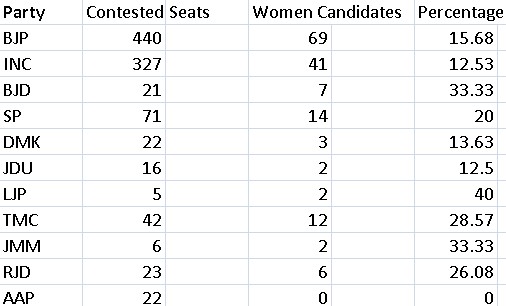
According to data from the Election Commission of India (ECI) and the Association for Democratic Reforms (ADR), a total of 8,337 candidates were in the fray for 543 seats in the 2024 Lok Sabha elections. Out of them, only 797 were women candidates from various parties. That is, women accounted for 9.55 per cent of the candidates fielded.
The BJP fielded candidates for 440 seats, out of which 69 were women (15.68% of its candidates). Similarly, the Congress fielded candidates for 327 seats, out of which 41 were women, which is 12.53 per cent.
The regional political party Biju Janata Dal (BJD) fielded candidates for 21 seats in Odisha, out of which 7 were women. That is, 33.33 per cent women candidates entered the election fray. However, none of them could open their account in the Lok Sabha.
Meanwhile, the All India Trinamool Congress (AITC/TMC) fielded 12 women candidates across 42 seats, amounting to 28.6 per cent. Out of these 12, 11 won the elections.
The JMM fielded 6 candidates, of which 2 were women, which is 33.33 per cent. The Lok Janshakti Party (LJP) contested 5 seats, of which 2 were women candidates. Their representation was 40 per cent. The Janata Dal (United)) fielded 16 candidates, of which 2 were women, which was 12.5 per cent.
The Samajwadi Party (SP) fielded 14 women candidates out of 71 total candidates, which is about 20 per cent. The DMK fielded 22 candidates, of which 3 were women (13.63 per cent).
The Rashtriya Janata Dal (RJD) fielded 6 women out of 23 candidates, which is 26 per cent. Notably, the Aam Aadmi Party (AAP) fielded 22 candidates in Delhi, Punjab, Haryana and Gujarat, but not a single one of them was a woman.
According to the Election Commission, out of the 2024 women candidates fielded by the parties, the following parties had 50 per cent women candidates: Naam Tamilar Katchi (50 per cent), Lok Janshakti Party (Ram Vilas) (40 per cent), BJD and JMM (33 per cent), RJD (26 per cent), TMC (28.57 per cent) and SP (20 per cent).
Alongside the 2024 Lok Sabha elections, polling was also held for Odisha’s 147-member Assembly. In terms of women’s representation, BJD fielded 33 candidates (22.44 per cent). The BJP nominated 12 women (8.16 per cent), while Congress fielded 20 (13.60 per cent). As in the Lok Sabha polls, the regional party BJD outpaced the national parties BJP and Congress in the state Assembly elections.