
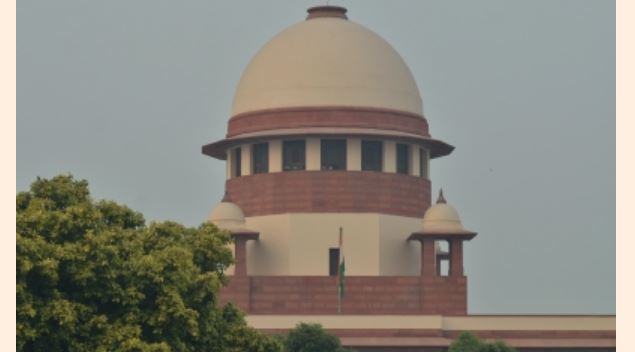
New Delhi: Supreme Court Friday directed the Centre and authorities to ensure that there is no complete prohibition of movement by Delhi Metro and trains to the capital due to a CJP protest October 10, saying they cannot bring everything to a halt.
Though law enforcement agencies have the right to take steps to restrict unruly movement, citizens should not be unduly harassed, the top court said.
The bench comprising Chief Justice of India (CJI) Surya Kant and Justices Joymalya Bagchi and V Mohana was hearing a plea against the closure of 57 metro stations and cancellation of trains to Delhi in view of the protest.
The protest call has been given by the Cockroach Janta Party (CJP) and some student organisations against Chief Election Commissioner Gyanesh Kumar over alleged irregularities in the functioning of the Election Commission.
“The only issue before us is whether the complete stoppage of metro trains and railway services from certain stations requires reconsideration,” the bench said.
It told Solicitor General Tushar Mehta, appearing for the Centre, that there is a distinction between complete prohibition and regulation of the movement of metro and other trains.
“The solicitor general has fairly agreed to impress upon the authorities to reconsider the prohibition and allow the movement of metro trains and other railway services in a suitably regulated manner so that no inconvenience is caused to the residents of Delhi and the public at large, keeping in mind the principle of proportionality.
Also Read : AAP to join CJP’s Oct 10 protest in Delhi: Sanjay Singh
“In terms of that assurance, we make it clear that there shall be no complete prohibition on the movement of metro trains,” the CJI ordered after hearing a battery of senior lawyers led by senior advocate Kapil Sibal in a packed courtroom.
The CJI said the restrictions must go no further than necessary to address the anticipated threat.
“You have to prevent certain things. Take measures only to the extent necessary to prevent them,” he said, adding that preventive action should not bring all movement to a halt.
The bench directed the Centre to give due publicity to the decision taken by the authorities regarding the movement of metro trains and other railway services.
It asked the Centre to take appropriate decisions in “a suitably regulated manner” to ensure that the “inconvenience to the public at large is minimised”.
During the hearing, the bench expressed serious concern over the closure of entry and exit gates at several Delhi Metro stations and the cancellation of trains.
“One should not use a hammer to kill a fly,” the bench said.
It said that while the law enforcement agencies are entitled to take preventive measures to maintain public order, these must be proportionate to the threat and should not cause undue hardship to ordinary citizens.
“We are mainly concerned about the complete closure of these metro station entries. We have serious concerns about this,” the CJI told Solicitor General Mehta at the outset.
The court said its concern was not with the protesters or any individual, but with thousands of commuters travelling every day from Gurugram, Greater Noida and other parts of the NCR to Delhi for work, education and other essential activities.
“They are students, employees and senior citizens who travel by public transport. We are speaking on behalf of the common citizens of this city,” the CJI observed.
“Everybody does not have a car. Everybody does not have access to private transport. People depend on public transport. This cannot be done,” he said.
The solicitor general initially submitted that the advisory contemplated a reduction in the frequency of metro trains passing through certain stations rather than their complete closure.
However, when he read out the provision stating that entry and exit at the identified stations would be closed from 9 am on Saturday until the situation normalises, the bench questioned the apparent inconsistency.
Justice Bagchi said such a measure would be difficult to accept when the same advisory referred to a reduced train frequency.
The CJI cited the difficulties that court staff, clerks, canteen workers and other employees could face in reaching their workplaces, observing that those without private vehicles would be particularly affected.
Mehta assured the court that he would consult the government and that restrictions could be regulated and periodically reviewed in light of the evolving situation.
The CJI also asked the authorities to review road closures and barricading, identify areas where restrictions are genuinely necessary and ensure the free flow of traffic wherever possible.
He stressed that maintaining law and order involved protecting people, not merely government property, and that the authorities must consider the needs of women, children, senior citizens and patients who depend on public transport.
“Citizens should not be unduly harassed. That is all we want,” the CJI said.
Senior advocate N Hariharan also raised concerns over extensive barricading across the city, arguing that even people travelling by private vehicles are being prevented from moving between different parts of Delhi.
Sibal, who said that he appeared for CPI(M) general secretary M A Baby, also flagged proposed restrictions on railway services, submitting that trains scheduled to arrive at New Delhi and Hazrat Nizamuddin railway stations during specified hours on Saturday are to be cancelled at their originating stations because of anticipated road congestion.
Sibal said the measure could prevent long-distance trains from reaching Delhi even when their journeys originated far outside the capital.
He cited examples of trains arriving from Kerala, many of which are scheduled to reach Delhi between 11 am and 1.30 pm on Saturday.
The submissions highlighted concerns that measures intended to manage the protest could disrupt travel for passengers who had no connection with the demonstration.
During the hearing, a senior advocate alleged that Delhi Police personnel visited mosques to discourage people from participating in the demonstration.
He said the allegations had been made on oath and referred to a photograph and video submitted to the court.
Mehta objected to the manner in which the issue was raised, describing it as an attempt at instigation rather than a genuine effort to seek justice.
The CJI, however, declined to comment on the allegations without hearing the authorities concerned.
Responding to the concerns raised by the bench, Mehta said the government would examine the restrictions but sought to explain the background to the security arrangements.
Mehta submitted that the organisers of an earlier protest had sought police permission on June 20 and were granted permission for one day, from 10 am to around 4 or 5 pm.
The organisers had given an undertaking to vacate the protest site after this period, but the demonstration continued for 17 days allegedly in violation of the conditions imposed, he said.
He further alleged that the protesters had subsequently attempted to march into a restricted area near Parliament and that more than 200 police personnel, along with some private individuals, had been injured in the resulting confrontation.
Mehta said the government has a responsibility to protect both the right to protest and the rights and safety of the wider public.
Addressing concerns over internet restrictions, the solicitor general submitted that the curbs were confined to areas around Rashtrapati Bhavan and Raisina Road, within an approximate radius of 4 km, and were reviewed according to the prevailing situation.
He also offered to place video recordings of the earlier confrontation on record, alleging that women police personnel had been assaulted, injured and subjected to abuse.