
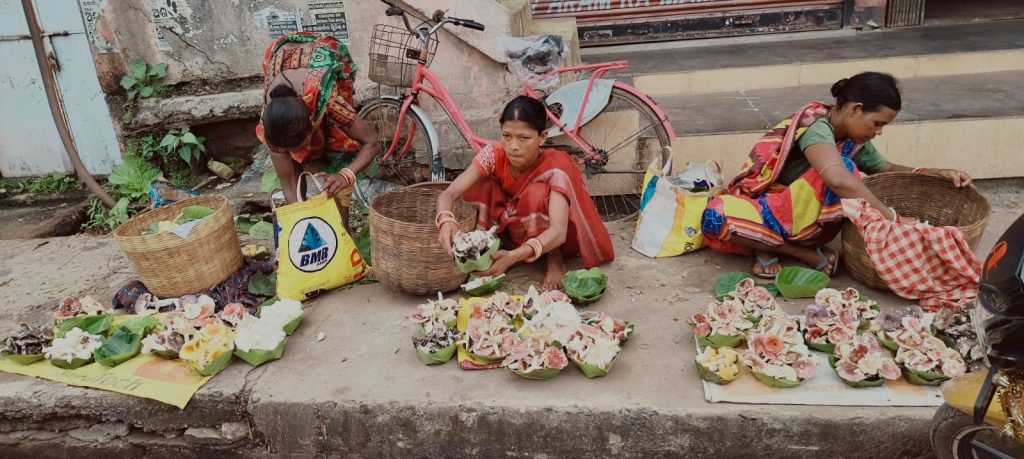
Kendujhar: With the arrival of monsoon, colourful wild mushrooms have emerged across the forests of Kendujhar district, drawing tourists and providing a seasonal source of income for tribal communities.
Forest dwellers collect edible wild mushrooms from forests and hill slopes to sell them in rural and urban markets. During the monsoon, the mushrooms are also sold along highways.
Rich in nutrients and prized for their taste, the naturally grown mushrooms remain in high demand. For nearly three months each year, many tribal families depend on mushroom collection and sales for their livelihood.
Among the most sought-after varieties is Rutuka, which fetches between Rs 600 and Rs 800 per kg because of limited supply and strong demand in urban markets.
Other popular varieties include Bali Chhatu, Bihuduni Chhatu, and Kuta Chhatu.
More than 30 varieties of colourful mushrooms grow in the district’s forests. They are used in a range of traditional delicacies and are also popular in restaurants.
Mushrooms are commonly found in the forested blocks of Banspal, Telkoi, Kendujhar Sadar, Ghatagaon, Joda, Champua and Harichandanpur.
“Forest dwellers collect mushrooms from forests, hill slopes and nearby lands and bring those to markets in bags and baskets.
However, they are often exploited by traders and do not receive fair prices,” said Dr Bimbadhar Behera, a retired professor.
Collectors typically sell mushrooms for Rs20 to Rs50 per leaf cone, while traders transport those to cities such as Bhubaneswar and Cuttack, where some varieties sell for more than Rs1,000 per kilogram.
Mushroom collection is not without risks.
Tribal collectors often face threats from snakes, bears and elephants while foraging in forests.
They also travel long distances on foot carrying the produce and are frequently cheated by middlemen through unfair pricing and inaccurate weighing.
According to local sources, the district’s seasonal mushroom trade is worth an estimated Rs10 lakh to Rs20 lakh annually.
However, collectors receive only a small share of the earnings because of the absence of effective government support and market intervention.