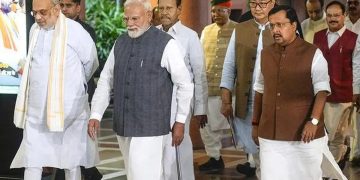
Recent events in Delhi deserve to be seen beyond the immediate confrontation between the government and the Opposition. Something deeper is taking shape in India—a crisis of trust between citizens, particularly the young, and institutions expected to stand above day-to-day politics. The Election Commission is a constitutional institution. The National Testing Agency was created as an autonomous body to conduct examinations. Yet controversies over electoral rolls and NEET have contributed to a growing perception, especially among young people, that institutions on which their future depends are not sufficiently transparent, accountable or independent. Whether every allegation is eventually proved is important. But the larger question is: why are so many young people beginning to doubt the fairness of the system?
The response of the State to youth protests is therefore significant. Barricades, restrictions, heavy police deployment and detention may control an immediate demonstration, but they cannot restore trust. A democracy cannot police its way out of a crisis of confidence. When peaceful protest is treated primarily as a law-and-order problem, the State may win the day but lose something more valuable—the confidence of citizens.


There is also a difference between a protest led by established political parties and a mobilisation of young citizens who do not see themselves as an extension of any political party. Governments understand political parties—their leaders, structures and electoral compulsions. A spontaneous youth mobilisation is more fluid, less predictable and potentially more enduring. I would hesitate to say that the government is “afraid of Gen Z” while taking the Opposition lightly. That is an interpretation, not an established fact. But an independent youth mobilisation does present a different challenge. The young people protesting today will constitute a substantial part of India’s electorate in the coming years. They can be offered employment, entrepreneurship, technology and development. They can also be dispersed through political co-option or fear. But one thing is much harder to manage: a generation that loses trust in democratic institutions themselves.
This is where Gandhi—and later Jayaprakash Narayan—offer an important lesson. Gandhi never regarded opposition to British rule as the whole of the freedom struggle. Satyagraha and non-cooperation were accompanied by a Constructive Programme: communal harmony, removal of untouchability, village industries, education, sanitation, health, work among peasants and labour, Adivasi welfare and the rebuilding of village societies. Constructive work was not an adjunct to political struggle. It was the preparation for Swaraj. Gandhi understood something contemporary politics often forgets: it is easier to mobilise people against something than to mobilise them for something.
Jayaprakash Narayan carried a related idea into a different historical moment through his call for Sampoorna Kranti—Total Revolution. His movement brought together students, citizens and political groups against corruption, authoritarianism and the erosion of democratic institutions. The restoration of democracy after the Emergency was undoubtedly a great victory for India. JP demonstrated that citizens, when morally mobilised, could challenge an overwhelmingly powerful political establishment.
But history leaves us with a difficult question: why did India, after such a powerful nationwide movement, return so quickly to many of its familiar political and social ways? This is not to diminish JP or the historic achievement of the movement. It is precisely because the achievement was so great that the question must be asked. The movement helped defeat authoritarianism, but Sampoorna Kranti did not become an equally sustained, nationwide, non-party constructive programme through which ordinary citizens could continue to practise the new democracy in their daily lives.
Political parties eventually occupied the space opened by the movement. Governments changed, but many deeper structures of inequality, corruption, centralisation and dependence on political power remained. The lesson is uncomfortable but necessary: a nationwide andolan can remove a government; it cannot by itself reconstruct a society. Political victory without social reconstruction can leave the political culture largely unchanged.
This is where Gandhi’s Constructive Programme becomes relevant again. Why should young people only protest? If they distrust the Election Commission, let them create non-partisan Citizens’ Election Watch groups to help citizens verify electoral rolls, understand correction procedures and document genuine irregularities. If they distrust examination systems, let students study how examinations are conducted and demand institutional reforms that protect millions of candidates. If unemployment concerns them, let them work with communities to develop livelihoods, skills and enterprises rather than waiting only for government recruitment. If climate change concerns them, let them restore water bodies, regenerate degraded land and work with farmers on ecological livelihoods. If the condition of villages concerns them, let every college adopt a cluster of villages and make health, education, sanitation, digital literacy and local economic development part of student citizenship. This would not mean withdrawing from protest. It would mean giving protest a constructive foundation.
The same principle applies to India’s forest regions. The defeat of Maoist violence is important; no society can permit armed violence to determine the future of its citizens. But the end of insurgency cannot become an automatic licence to transfer forests and natural resources to large corporations without considering the rights and livelihoods of forest-dwelling communities and the ecological consequences. Gandhi would ask: development for whom, and decided by whom? A constructive programme would bring together Gram Sabhas, Adivasi communities, young people, ecological knowledge and responsible investment. Development need not mean rejecting industry. But it must enlarge the capabilities, livelihoods and dignity of local people rather than merely transfer their resource base elsewhere.
The Opposition, too, has a responsibility. It should not merely inherit the anger of the young or convert every youth mobilisation into another political rally. If the Opposition wants to become a credible alternative, it must demonstrate what different politics would mean in education, employment, institutions, villages, forests and the everyday lives of citizens.
The young need not become another Opposition. They could become an independent democratic force that questions every government but belongs to none; that protests when necessary but constructs continuously; that demands accountability from institutions while practising accountability itself. This is what Gandhi understood by Swaraj. It was not simply the transfer of power from British rulers to Indian rulers. It began with self-regulation, extended to the capacity of communities to govern themselves, and required citizens capable of resisting domination without becoming instruments of domination themselves.
The writer is the former Vice Chancellor of Gujarat Vidyapith, the University founded by Mahatma Gandhi in 1920. ©The Billion Press