
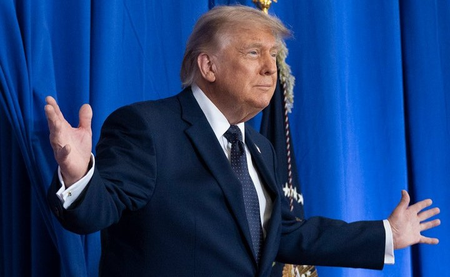
US President Donald Trump’s craving for long-lasting fame is well known. It assumed scandalous proportions while he was pursuing the Nobel Peace Prize. After being denied the honour, Trump sought to snatch it from the 2025 winner Maria Corina Machado, whom he might have been betting on as the opposing political voice against former president Nicolas Maduro of Venezuela who was arrested by Trump’s government and is still in US detention.
In a meeting with Trump after receiving the prize, Machado handed the prize catch to him apparently to massage his ego in lieu of political patronage from him. He had no qualms in accepting it, even though the Nobel committee made it clear the honour could not thus be misappropriated from the recipient chosen by the committee.
It is another matter that Machado probably did not gain much political clout in Venezuela even after this stunt. One of the surest signs of an authoritarian regime is the all-pervasive presence of its leader. This has been witnessed throughout history across the globe. Mussolini’s face was plastered across fascist Italy.
In North Korea, pictures of Kim Jong-un alongside those of his father and grandfather can be found in every home and public building. The golden statue of Turkmenistan’s leader, Gurbanguly Berdymukhamedov, perching on a marble cliff in the capital is an example of the autocrat’s self-glorification.
Back home also, the face of the Prime Minister can be seen everywhere, from rail stations and airport walls to petrol pumps and beyond. Democracies are expected to shun such ostentatious displays but such ethical lines seem to be blurring everywhere nowadays. The first US President George Washington had refused to appear on currency.
But the 47th President Donald Trump has no such concerns. Now the administration is going ahead with its plan to print the image of Trump on a $250 bill to commemorate the 250th anniversary of American independence on 4 July. The federal law, however, does not currently allow banknotes to depict living people.
Trump’s signature will soon appear on $100 bills: a first for a US President. Already, immense banners with Trump’s face were put up at the departments of justice, labour and agriculture in Washington last year. He reportedly offered to release federal funds for infrastructure if Dulles airport and Penn station were renamed in his honour.
Trump is on a monument-building spree, including the $1.4 billion White House ballroom project. His path of blatant image-building is not smooth as a judge a few days back ordered the removal of his name from the Kennedy Center, saying the arts venue could not be renamed without Congressional approval.
Americans have made their views clear. In Pew Center research last month, only 9 per cent said it was acceptable to name government buildings after Trump while he is in office, while 50 per cent opposed it outright. The irony is when the US President is busy trying to get the image of his face printed on bank notes, his voters struggle to pay the bills.
Federal law bars printing US money with the image of a living person, but Trump allies in Congress have introduced legislation that would make an exception. A Treasury Department spokesperson said the agency “is conducting appropriate planning and due diligence” in response to the legislation.
The lawmakers behind it said the bill amount would symbolise the country’s 250th anniversary this year. If approved, it will be the latest example by Trump and his allies to put his face, name, and likeness on national institutions and symbols.
The new legislation was introduced last year by US House Representative Joe Wilson, a Republican from South Carolina. As Americans struggle with the rising cost of gas, groceries, housing and healthcare, Trump’s priorities for taxpayer dollars are completely divorced from the ground reality of families finding it so hard to make both ends meet. The situation is similar in other democracies where authoritarianism has taken hold.