By SRIDHAR MOHARANA, OP
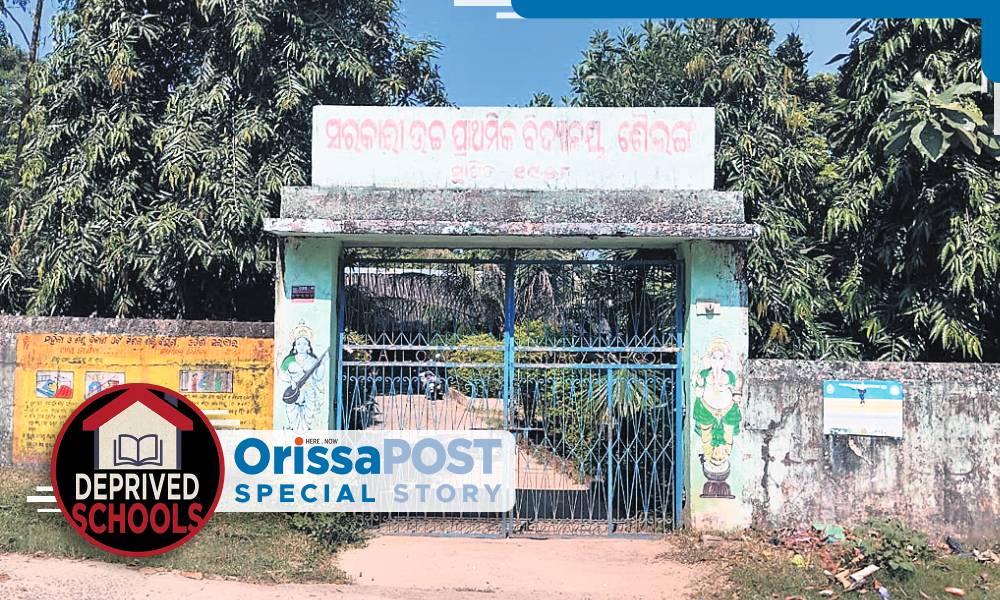
Anandapur: Despite the National Education Policy (NEP) 2020’s emphasis on modernising education, a government upper primary school at Shailanga village under this block in Kendujhar district continues to grapple with inadequate classrooms, teacher shortages and dilapidated infrastructure, highlighting the gap between policy and ground realities.

Established in 1958, the Government Upper Primary School in Ward 16 of Anandapur Municipality has 117 students from Sishu Vatika (pre-primary) to Class VIII, but only four teachers to manage nine classes. The newly appointed headmistress, Pratibha Manasisa, who took charge August 24 following her predecessor’s promotion, expressed concern over the school’s deteriorating condition.
She said at least six teachers were needed to ensure that teaching was not affected by additional responsibilities, including the mid-day meal programme, training sessions and administrative work. A shortage of classrooms has forced students of multiple classes to study together. Children from Sishu Vatika to Class II share one room, while Classes III and IV, Classes V and VIII, and Classes VI and VII are taught in shared classrooms.
In the absence of a separate office, administrative work is also conducted in a classroom, further aggravating the space crunch. The school building is in a dilapidated state, with cracked classroom walls and rainwater leaking through the asbestos roof. The compound wall on the southern side of the entrance has also collapsed.
Although the school has enough toilets for its student strength, overgrown creepers and bushes around the facilities pose a potential threat from snakes and other reptiles. The tube well water is reportedly contaminated, forcing students and staff to rely on the civic body’s water supply.
With no separate kitchen, mid-day meals are prepared in an old, abandoned classroom. No government funds have been received for the school’s development since 2014. Anandapur block additional education officer Hemendra Prasad Mohanty and cluster resource centre coordinator Agyan Kumar Rout said differences between old and new residents had long prevented the formation of a school management committee.
Former committee president Sudarshan Sa said the authorities had been repeatedly informed about the problems, but no corrective action had followed. Parent Nakul Charan Sahu said the shortage of teachers and classrooms had seriously affected learning, adding that repeated appeals to the education department had gone unanswered.
A teacher said the meagre annual composite grant was spent on cleaning, repairs and essential maintenance, leaving little scope for further improvements.