
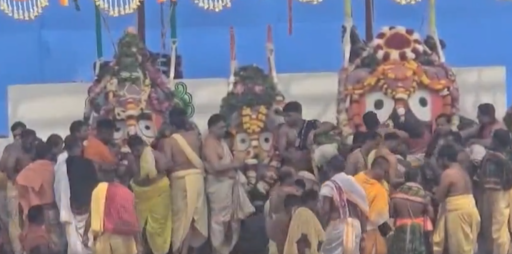
Puri: Braving hot and humid weather, lakhs of devotees Monday witnessed the ceremonial bathing ritual of Lord Jagannath and his siblings, followed by the unique ‘Gaja Besha’ (elephant attire), at the 12th-century shrine in Odisha’s Puri.
The ‘Snana Yatra’, one of the most significant rituals in the Jagannath temple calendar, marks the beginning of the annual Rath Yatra festivities.
As part of the tradition, the ‘Mool Bigraha’ (original wooden deities) of Lord Jagannath, Lord Balabhadra, Goddess Subhadra and Chakraraj Sudarshan were brought out from the sanctum sanctorum in the ceremonial ‘Pahandi’ procession amid the blowing of conch shells and chants of “Hari Bol” on the occasion of ‘Jyestha Purnima’, also known as ‘Deva Snan Purnima’.
The deities were placed on the elevated ‘Snana Mandap’, allowing devotees gathered on the Grand Road to witness the sacred bathing ceremony.
According to the ‘Skanda Purana’, King Indradyumna, who installed the wooden deities in the shrine, introduced the bathing ritual. The day is also believed to mark the birthday of the divine siblings.
After the deities were seated on the bathing platform, servitors performed the ‘Mangala Aarti’, the first ritual offering after the opening of the temple. On ‘Snana Purnima’, devotees are allowed to witness the ‘Mangala Aarti’ from an open pavilion.
Amid the chanting of Vedic hymns, the deities were bathed with 108 pitchers of sacred water drawn from the temple’s ‘Sunakua’ (golden well). Lord Jagannath was bathed with 35 pitchers, Lord Balabhadra with 33, Devi Subhadra with 22 and Chakraraj Sudarshan with 18 pitchers.
Following the bathing ritual, Puri’s titular king, Gajapati Maharaja Dibyasingha Deb, performed the ceremonial sweeping of the ‘Snana Mandap’. The deities were then adorned with the iconic ‘Gaja Besha’, symbolising Lord Ganesha.
Jagannath culture researcher Bhaskar Mishra said the materials for the traditional Gaja Besha are supplied by the centuries-old Raghav Das Mutt and Gopaltirtha Mutt.
In the evening, devotees were allowed to have close darshan of the deities during the ‘Sahan Mela’ on the ‘Snana Mandap’.
Thereafter, the deities will be taken to the ‘Anasara Ghar’ (isolation chamber), where they are believed to fall ill after the ceremonial bath and remain away from public view for 14 days. ‘Baidyas’ (ritualistic physicians) will administer herbal treatment during this period.
Public darshan will resume on ‘Nabajouban Darshan’, a day before the annual Rath Yatra.
Chief Minister Mohan Charan Majhi, Union Education Minister Dharmendra Pradhan, MPs and MLAs, offered prayers at the ‘Snana Mandap’.
“I have prayed for the well-being of the people of Odisha and the entire world. Odisha will certainly prosper and contribute to global welfare by the grace of Lord Jagannath,” Majhi said.
Shree Jagannath Temple Administration (SJTA) Chief Administrator Arabinda Padhee said all rituals were being conducted smoothly as per schedule.
“We urge devotees to cooperate with the administration for the smooth conduct of the festival,” he said.
Security was tightened across Puri with the deployment of nearly 2,400 police personnel, IG (Central Range) Satyajit Naik said.
Puri Collector Divya Jyoti Parida said elaborate arrangements had been made by various departments to minimise inconvenience for devotees.
“Despite measures such as water sprinkling along the Grand Road, several elderly devotees and women reportedly fell ill due to the hot and humid weather. An incident of devotees breaching barricades was also reported but was promptly brought under control by the police,” ADG Soumendra Priyadarshi said.
SP Prateek Singh said some devotees suffered heat-related illness.
During his visit, the CM met ‘Gajapati Maharaja’ Dibyasingha Deb at the palace and later inspected the ‘Rath Khala’, where artisans are building the three chariots for the upcoming Rath Yatra.