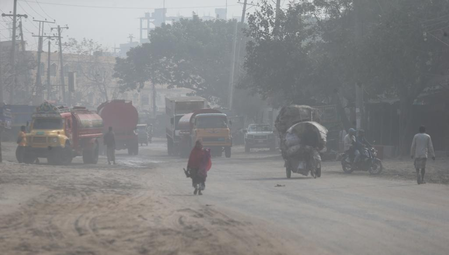
Dhaka: Bangladesh’s capital, Dhaka, was ranked first among the world’s most polluted cities Tuesday, with an Air Quality Index (AQI) of 213 at 11:10 a.m. (local time), local media reported.
According to the AQI scale, the air quality in Dhaka was labelled as “very unhealthy”, indicating a serious health alert where people may experience health effects, United News of Bangladesh (UNB) reported.


Malaysia’s Kuala Lumpur has been ranked second among the world’s most polluted cities with an AQI of 208, while Singapore ranked third as it recorded an AQI of 179.
According to AQI standards, a reading above 301 is considered ‘hazardous’; a reading between 201-300 is considered ‘very healthy’; a reading between 151-200 is classified as ‘unhealthy’; while a reading between 101-150 is deemed ‘unhealthy for sensitive groups.’
Bangladesh’s Dhaka has been grappling with air pollution for a long time, with air quality usually deteriorating during winter and improving during the monsoon season, UNB reported.
The AQI is calculated on the basis of five major pollutants: particulate matter (PM10 and PM2.5), nitrogen dioxide (NO2), carbon monoxide (CO), sulfur dioxide (SO2) and ozone.
According to the World Health Organisation (WHO), air pollution causes seven million fatalities each year across the world, mainly due to heart disease, stroke, chronic obstructive pulmonary disease, lung cancer and acute respiratory infections.
WHO data has indicated that almost all of the world’s population (99 per cent) breathes air that is more than guideline limits set by WHO and contains high levels of pollutants, with low- and middle-income nations suffering from the highest exposures.
In July, a study conducted by researchers at Jahangirnagar University revealed that air pollution caused by fine particulate matter (PM2.5) kills an estimated 242 people every day in Bangladesh’s six major cities and causes an economic loss of around $23 billion annually, Bangladesh-based daily The Daily Star reported.
According to the study, PM2.5 pollution causes about 88,240 premature deaths each year in Dhaka, Chattogram, Rajshahi, Khulna, Sylhet and Barishal — equivalent to roughly 260 deaths per 100,000 people. The study estimates that Bangladesh faced an economic loss of nearly $23 billion annually from PM2.5 pollution, The Daily Star reported.
The study analysed data conducted by the Climate Change, Air Quality and Health Research (C2AHR) Unit under the Department of Public Health and Informatics at Jahangirnagar University analysed the data from 2013 to 2021.