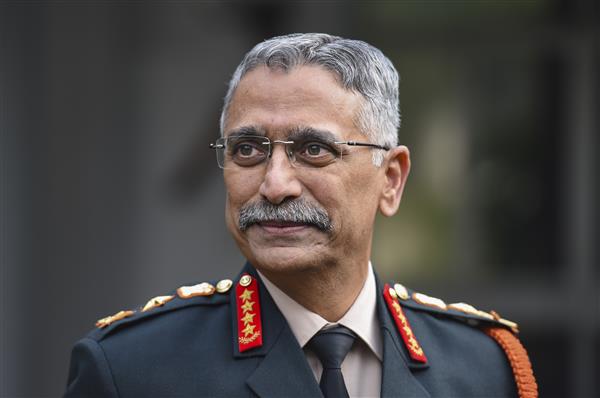
New Delhi: Former Army chief Gen Manoj Naravane has come out with two books since his unpublished memoir, Four Stars of Destiny, caused a controversy earlier this year and looking back, he said it was not warranted to unnecessarily quote and drag him into the limelight for the book.
The general, who recently released The Curious and the Classified Unearthing Military Myths and Mysteries, said that he has moved on since then and has already written two books and a third will soon be released.

The Ministry of Defence had asked the publisher to put it on hold till it was vetted. As far as I am concerned, the matter rested there, and I have moved on so that is a closed chapter. And unnecessarily quoting me and dragging the unpublished book into the limelight and indirectly me to the limelight was, I think not warranted, Naravane told PTI Videos in an interview.
In February this year, Congress leader Rahul Gandhi was stopped from citing excerpts from the memoir in the Lok Sabha, as it had not yet been published.
Naravane’s writing career has taken a turn since the episode, as his latest book is supposed to be an entertaining read and not a serious academic endeavour.
Also Read : Pakistan deploys air deception to protect Iran delegation flight
The Curious and the Classified Unearthing Military Myths and Mysteries, published by Rupa Publications, explores some of the most riveting nuggets about the legends and lore of the Indian Army, Navy and Air Force.
Naravane, in the book, traces the origins of the ubiquitous military greeting Jai Hind from the freedom movement to its adoption by the Indian armed forces.
He said that Jai Hind was first used by the Indian Air Force and only later embraced by the Army and Navy, adding that the standard practice of saluting was originally silent, with regiments adding their own greetings like Sat Sri Akal or Ram Ram.
It was initially the Air Force that started saying ‘Jai Hind’, and we have now followed that across all three services. With the salute, we say ‘Jai Hind’, and even in lectures, we greet with ‘Jai Hind’.
But where does this ‘Jai Hind’ come from? You realise it has got much deeper roots. And that was a revelation to me also. So it was something even I did not know about, I must have said ‘Jai Hind’ a million times, Naravane said.
The former Army chief delves into the legends of Badluram, a soldier of the Assam Regiment, and a military mule named Pedongi.
Badluram died in the Battle of Kohima in 1944, but rations allotted to him kept arriving after his death, helping the besieged company to survive the war.
The story inspired British Indian Army officer Major M T Proktor to write a foot-tapping song, Badluram ka Badan, that has become the unofficial regimental anthem of the Assam Regiment and is sung at their functions.
…the lyrics go ‘Badluram ka badan zameen ke neeche hai. Lekin uska ration hum khaate hain,’ and it became a very famous song. It is a very foot-stomping song, and you can dance to it, and it raises your morale. Although people have heard the song, very few know it has got such deep roots in an actual battle which turned the tide of probably the Indian course of history, he said.
On the legendary mule Pedongi, captured by Pakistan in 1971, which escaped and returned to its unit through minefields, Naravane said the animal was honoured with retirement and served 37 years.
The Pakistanis started using it to carry their loads and at one point in time, this particular mule had a machine gun and some ammunition loaded on it, and it decided to come back home. It escaped its captors, negotiated the treacherous terrain and the mine fields, and came back to its unit through sheer homing instinct, the general recalled.
In a way, it was an act of valour, bravery, and loyalty. It was then showered with honours and awards, and it was also decided that it would no longer carry any loads, unlike any other mules, and was put into a sort of retirement till it died of natural causes after 37 years at Bareilly, he added.