
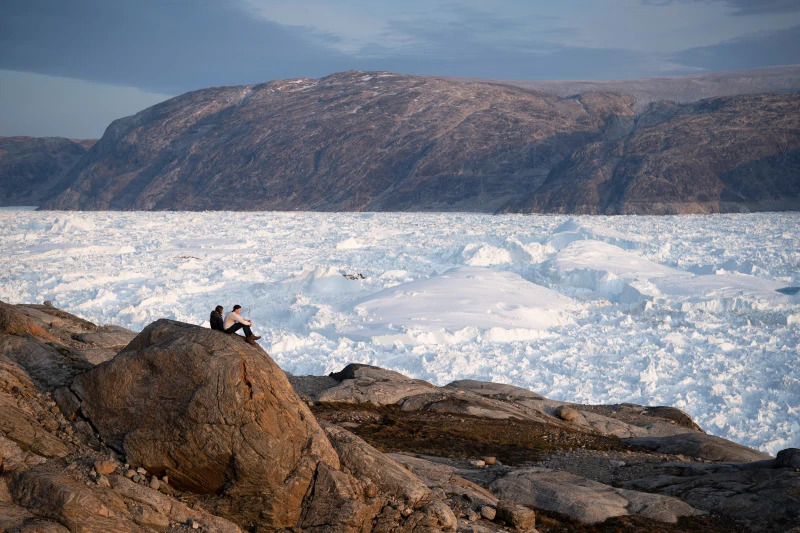
About 12.5 trillion tonnes (11.3 trillion metric tonnes) of ice from glaciers in Greenland and Antarctica have melted since 1979 — enough frozen water to cover the continental United States with ice 5 feet (1.5 metres) deep, according to a major scientific report.
A warming Earth is accelerating the melting of the planet’s two major ice sheets. Five-sixths of the ice loss is not caused by hotter air, but by warmer waters eating away at the ice sheets from below and the sides, causing glaciers to flow into the oceans, according to a study published Wednesday in Scientific Data. The authors said the trend is bad news for future sea-level rise. “The ice sheets are melting away fast,” said study co-author Eric Rignot, an ice scientist at the University of California, Irvine. “We are melting the polar regions; sea level is rising worldwide and will exacerbate the vulnerability of coastal regions.” All that melted ice became nearly 3 quadrillion gallons (11.3 quadrillion litres) of water, raising global sea levels by about an inch (3.1 centimetres) since 1979, on top of other climate factors raising ocean heights.
An inch may not sound like much, but for every third of an inch (or centimetre) of sea-level rise, another 2 to 3 million people are flooded at least once a year, said lead author Ines Otosaka, an ice scientist at Northumbria University in England. The Jakobshavn glacier in Greenland is now retreating by up to 164 feet (50 metres) a day, Otosaka said. The international collaboration of polar scientists, led by the European Space Agency, previously examined ice-sheet melt only since the 1990s using European satellite data. By incorporating NASA satellites, researchers were able to chart ice-sheet volumes in Antarctica back to 1979 and Greenland back to 1972.
The study found the ice sheets were relatively stable in the 1970s, 1980s and into the 1990s, but melting accelerated and intensified in the 2010s. “There is a clear trend that the ice sheets are losing more mass,” Otosaka said, adding that the pattern is linked to climate change. Study co-author Andrew Shepherd said the changes could continue for decades even if global warming were halted, because the ice sheets are responding to warming with a delay of decades. The accelerating melt appeared to pause from 2020 to 2023, but the authors attributed this to short-term weather variations rather than a change in the long-term trend. Antarctica’s stability was partly due to record snowfall in East Antarctica, which offset rapid melting in West Antarctica.
The study used 45 independent surveys and 27 satellites. New York University ice scientist David Holland, who was not involved, said the independent methods increased his confidence in the findings and that the upward trend is real. Scientists are particularly concerned about “dynamic” ice loss, in which glaciers rapidly discharge ice into the ocean, potentially contributing to instability and tipping points.
Orissa POST – Odisha’s No.1 English Daily