
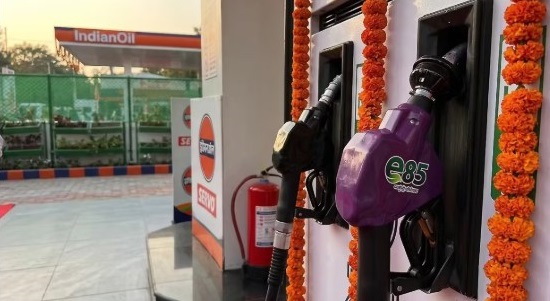
On World Environment Day, 5 June, India launched E85, that is, petrol blended with 85 per cent ethanol at 48 public sector fuel stations in various parts of the country exclusively for flex-fuel vehicles. Priced about Rs 20 cheaper per litre than conventional petrol, E85 is being sold by the government as a win-win solution that would reduce the country’s massive crude oil imports, support its sugarcane farmers and lower fuel costs for consumers. However, the policy is facing massive backlash on social media with critics raising serious economic, environmental and consumer concerns over the move that policymakers appear unwilling to address.
The “Rs 20 cheaper” price advantage, as propagated by the government, conceals the fundamental fact that ethanol generates significantly less energy than petrol. This is the reason, experts point out, that vehicles running on E85 can experience a 20-30 per cent drop in mileage. If a vehicle user has to burn substantially more fuel to travel the same distance, the apparent savings at the petrol pump come to nought. A fuel that is 20 per cent cheaper but delivers 20-30 per cent lower mileage may force motorists to shell out more while being told they are benefiting from a discount. In this scenario, it is the ethanol industry, not the consumer, which becomes the primary beneficiary of the government’s biofuel policy push. The government’s aggressive promotion of ethanol coinciding with the exponential financial growth of CIAN Agro Industries, a listed agribusiness and renewable energy company managed by Nikhil Gadkari, son of BJP leader and Union Minister Nitin Gadkari, has already drawn significant public and media attention.
Not just at the fuel station in the long run, the consumer also has to pay more while buying a vehicle. Flex-fuel vehicles, specifically designed to handle high ethanol blends, are likely to cost more than conventional models because they require specialised components and engine modifications. This would lead to a double burden on the motorist in the form of higher upfront vehicle costs and lower mileage.
Coming to vehicle longevity, ethanol is more corrosive than petrol and absorbs moisture from the atmosphere. Therefore, high ethanol blends can accelerate wear and tear in older vehicles. Even in flex-fuel vehicles, prolonged use of high ethanol concentrations can increase maintenance requirements. These factors will have a telling impact on the resale value of vehicles.
The biggest catch lies in the narrative around biofuels like ethanol, which is often marketed as a green fuel because it is derived from crops rather than fossil fuels. Yet the environmental footprint of ethanol production is far more complex than what the government wants citizens to believe. The ethanol industry in India is heavily reliant on sugarcane and grain-based feedstocks. Sugarcane is among the most water-intensive crops grown in the country. Producing a litre of ethanol requires thousands of litres of water when the entire cultivation process is taken into account. At a time when large parts of India are grappling with groundwater depletion, erratic monsoons and recurring droughts, diverting precious water resources towards fuel production appears deeply flawed. This is more so in states like Maharashtra and Karnataka, where sugarcane cultivation already places immense burden on water resources. Expanding ethanol production could encourage greater cultivation of water-intensive crops in regions that can scarcely afford it.
Also, ethanol is produced from crops grown using heavily subsidised fertilisers, electricity and irrigation. These subsidies were originally intended to enhance food security and support agricultural production. Increasingly, however, public resources are being channelled into producing fuel rather than food. This food versus fuel debate, long associated with biofuel policies in other countries, is now becoming relevant in India. Using agricultural land, water and fertilisers to produce fuel can distort cropping patterns and potentially affect food prices, particularly during years of weak monsoon.
Reducing dependence on imported crude oil is essential for a country like India, as has been learnt the hard way by Indians during the ongoing conflict in West Asia. But that doesn’t mean energy security should be achieved at the cost of consumer welfare, water security and vehicle durability. An energy policy that offers questionable economic benefits, increases pressure on scarce natural resources and relies heavily on public subsidies deserves far more scrutiny than it is being received in India.
The larger message coming out of this forceful biofuel promotion is that once again the government has in its agenda the interest of just one individual while formulating a policy that affects the entire country and its citizens.