
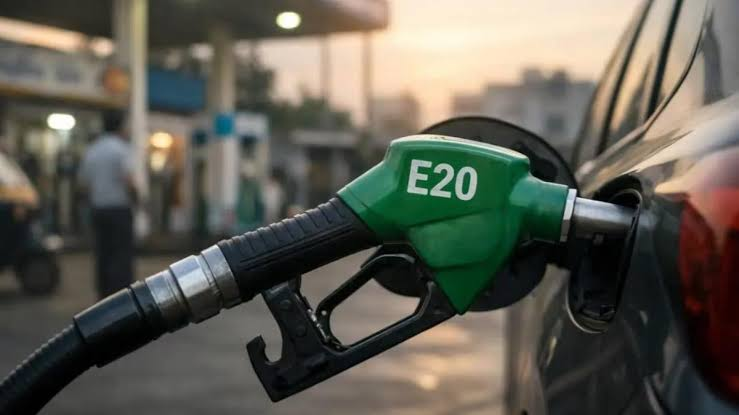
India’s rapid rollout of E20 fuel has been projected as a major step towards energy security, climate action and farmer welfare. The government deserves credit for reducing dependence on imported crude oil and creating a larger market for domestically produced ethanol. Yet an equally important question remains: has this transition been supported by sufficient scientific evidence and technical preparedness?
Public policy succeeds not only because its objectives are sound but because it earns public trust. That trust is built on transparent scientific evidence, rigorous long-term testing and clear communication. On these fronts, India’s ethanol programme still leaves several important questions unanswered.
Union Ministers Nitin Gadkari and Hardeep Singh Puri have consistently advocated higher ethanol blending to strengthen India’s energy security. Their rationale is compelling. India imports nearly 80-85% of its crude oil, making the economy vulnerable to global price fluctuations and geopolitical disruptions. Expanding ethanol production can reduce oil imports, lower greenhouse gas emissions and create an additional market for sugarcane and grain farmers. These are important national objectives. However, sound objectives cannot substitute for scientific validation. Although the government and automobile manufacturers state that E20 petrol is safe for compatible vehicles, many consumers remain concerned about fuel economy, engine durability and the performance of older vehicles. Officials often attribute such concerns to misinformation, yet the limited availability of publicly accessible, independent studies has inevitably contributed to public scepticism.
Brazil is frequently cited as the model for ethanol adoption, but its experience offers an equally important lesson in scientific and institutional evolution. The country’s biofuel programme began in the 1970s following the global oil crisis and matured gradually over five decades. During this period, Brazil expanded sugarcane cultivation, strengthened ethanol production capacity, modernised vehicle technologies, upgraded fuel distribution infrastructure and continuously refined regulatory standards. Ethanol blending increased progressively as scientific knowledge, engineering capabilities and consumer confidence evolved together. Brazil’s success was therefore built not merely on ambitious policy but on sustained investment in research, technological development and phased implementation. India’s transition, by contrast, has progressed much more rapidly. Nationwide availability of E20 fuel has been achieved ahead of schedule, and discussions have already begun on higher ethanol blends. While rapid implementation reflects administrative efficiency, the pace of policy should not outstrip the pace of scientific validation.
The need for Indian evidence is particularly important because India’s vehicle fleet and operating conditions differ substantially from those of Brazil. Millions of vehicles currently on Indian roads were manufactured before E20-compatible engines became common. They operate under diverse climatic conditions, varying fuel quality, inconsistent maintenance practices and highly heterogeneous driving patterns. Consequently, conclusions drawn from studies conducted elsewhere cannot be assumed to apply universally to Indian conditions.
Several scientific questions deserve clear answers. How does continuous use of E20 affect engines after 10 or 15 years? What are its effects on fuel pumps, injectors, rubber seals and metallic components under Indian conditions? Does ethanol alter emissions over a vehicle’s lifetime? How does it affect fuel efficiency across different vehicle categories? How do older vehicles perform after prolonged exposure? These are legitimate scientific questions, not arguments against ethanol itself.
Consumer choice is another important consideration. In many parts of the country, motorists have limited access to lower ethanol blends despite differences in vehicle compatibility. A more gradual transition would allow consumers to select fuels appropriate for their vehicles while confidence in higher blends continues to grow. If the evidence supporting E20 is robust, comprehensive testing data, independent evaluation reports and peer-reviewed studies should be made publicly accessible. Transparency is the strongest foundation for public trust.
The debate also extends beyond automobiles. Ethanol policy has implications for food security, water resources and agricultural sustainability. Sugarcane is one of India’s most water-intensive crops, and expanding ethanol production without improving water-use efficiency could increase pressure on already stressed groundwater resources. Greater use of agricultural residues, damaged grains and second-generation biofuels would improve the sustainability of the programme.
India undoubtedly needs biofuels as part of its clean-energy transition. However, biofuel policy should remain science-driven, technology-neutral and transparent. Ethanol should complement other low-carbon transport options such as electric mobility, green hydrogen, compressed biogas and synthetic fuels.
Brazil’s experience demonstrates that lasting success comes from combining ambition with patience and scientific rigour. Rather than mandating E20 for all consumers, the government could continue offering multiple fuel options, including E5, E10, E20 and conventional petrol, allowing motorists to choose fuels compatible with their vehicles. Appropriate pricing policies that make ethanol-blended fuels economically attractive would encourage voluntary adoption. At the same time, automobile manufacturers should intensify research and development to produce vehicles capable of operating efficiently on even higher ethanol blends, with E30 compatibility becoming a realistic target for future models.
As with every major energy transition, policy ambition must be matched by scientific credibility.
The writer is a scientist.