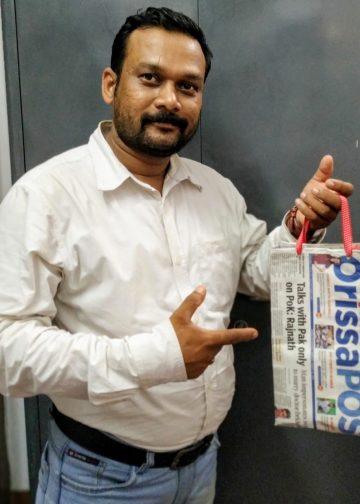
Megha Aryan, OP
WhatsApp’s encryption is the only obstruction to the government’s ability to act on reported content. The government would otherwise be able to use laws that are already in place to punish people for spreading fake news.


Half of the country’s population wakes up and check their phone messages, while rest do scroll through short news feeds on popular social media sites like Facebook and WhatsApp. Currently millions of people would have been scrolling down the news feeds, laughing on the memes, tagging friends to some hilarious posts and it also includes the “responsible” citizens who are sharing fake news without cross-checking it’s sources or doubting its authentication. But here the question arises, who is the evil doers? Who is regulating the fake news against ones religion on the popular social media platform? And are the users solely responsible for the circulation of fake news on internet?
“A viral video claiming to show a Hindu girl being lynched by a Muslim mob or visa-versa regularly does the rounds on WhatsApp with a plea to the receiver to send on the message with the hope that authorities will be pressurised into taking action. Such audio messages have become a comman ranting on WhatsApp with no truth at all. Every time the videos are old and it is circulated on WhatApp by adding the audio clip in it, mostly during festivals just to create outrage among the different religion. In fact a majority of the videos, seem to be propagated by people with hardline sensibilities and many have an anti-Muslim or anti-Hindu slants”, said an advocate, Ajit Kumar Satpathy.
“No one actually knows the real sender of the message or from where the message has originated. Thus, no one can find out the culprit. It is strange that despite having IT law and Cyber crime cell, nothing can have a grip over the messages send via WhatsApp”, he added.

Kundan Kumar, an avid reader of Hindu Mythology says: “The painting I saw on my Facebook home page was about Krishna stealing clothes of Gopis. And Gopis were begging God to return their clothes. The caption of the picture was “an eve teaser Krishna and we call him a God”. It really shocked me. The person responsible for the post, has he not read Krishna Charitas of Bankim Chandra Chattopadhyay? And without digging into Hindu mythology, how can one give such lame judgments? Had he read the book, he would have known that Krishna wasn’t stealing the cloths but was awaring the Gopis about the men peeping from the bushes to get look of their naked body.”
Well, India is the largest market for WhatsApp, as it constitutes more than 200 million users from a total of 1.3 billion all over the world. For last few years the social media has not only achieved the maximum attention for the users but has also gained popularity in spreading the obscene messages. Millions of messages are being shared and sent in a day by people around the world on the social media groups or inboxes. Facebook-owned WhatsApp is one of the prime targets these days for spreading fake news. However, the popular messaging app is exploring ways to check the spread of fake news through its platform but it is still a long way to go.
From videos circulating during Muzaffarnagar riots to GPS enabled currency after demonetisation, Indians have witnessed various forms of fake news on the WhatsApp platform from which some of it turned deadly for our people.
“Part of the challenge, is that WhatsApp, which is the main medium of fake news in India, is like a mutating virus. WhatsApp has end to end encryption. What that means is every message sent between two parties has a unique set of keys, regardless of whether it is the same message being passed on. This means that when fake news happens, there is no trail. It becomes tough for even WhatsApp to track”, said Kolkata-based software engineer Md Naim.
“Explaining the mechanism of the end-to-end encryption, WhatsApp does not store any message on its server and only the sender and receiver can see the message. The message is stored on the server in an encrypted format and once the receiver reads the message, it is deleted from our servers. In case the receiver does not read the message (seen as two ticks on the sender’s phone) within 30 days, it is purged,” Md Naim added.
In one of the interviews, the Indian Minister for Electronics and Information Technology admitted that the country is “helpless.” It’s unable to access “objectionable” content because of encryption.
WhatsApp’s encryption is the only obstruction to the government’s ability to act on reported content, added the minister. The government would otherwise be able to use laws that are already in place to punish people for spreading fake news.
India is not the only country expressing frustration with encryption. Countries such as Australia and the UK have cited security concerns when calling for tech companies, especially Facebook’s WhatsApp, to give authorities access to content when required. While no backdoors to encrypted content have been created, companies are responsive to governments’ repeated calls for action to fight terrorism.
“Many fake headlines are being created to simply drive traffic to websites for the purpose of earning advertising money. And users take the opportunity to blame the Facebook founder Mark Zuckerberg for not doing more to block such content on his influential social media platform, which now has more than two billion users worldwide but what the user don’t understand is that to fight with fake news, which is deeply rooted is not a single persons’ business nor of any organisation until the whole world fights for it together”, says a Facebook user and an engineer, Yashash Gaurav.
Sunday post asked few persons to know their take on fake news. Out of ten persons we talked only a few knew that fake news is circulated by social media while rest of them thinks everything they read is true. When we asked a vegetable seller if the messages they read on WhatsApp is true or not? He replied with a question, “Is there any incorrect information on Whats App? I don’t think so. And my brother usually sends me useful messages with social morals at the end. I trust whatever he sends me. I don’t doubt on my brother”, Sameera, a shopkeeper said.
In a conversation with another shopkeeper, Ratan, who gave the similar response to the question. He said that he believes in whatever he reads on the social media sites. He believes in it most of the time, without giving it a second thought.
Like Ratan and Sameera, there have been many others who had similar response when asked about their doubt on the content of the social media. But there a few people who prefer cross checking before believing in what they read.
Jayadev Kar, a Lecturer in Balimela College of Malkangiri said, “India is a democratic country. Everyone has the right to practice their religion without insulting others religion. But what is trending on internet is a real shame for us. And bigger shame is, we do share such posts or messages which insults other religion. We have been living in a secular country for so long.”
Most people seem to agree that “fake news” is a big problem online, but what’s the best way to deal with it? Is technology too blunt an instrument to discern truth from lies, satire from propaganda? Are human beings better at flagging up false stories?
WhatsApp is taking a number of steps, which includes educating users to explain that they should check authenticity of content before sharing it on the platform. For last two years, instances of objectionable videos being shared through WhatsApp have been noticed. Since WhatsApp did not have content of the messages available with them, their ability to take action was limited. WhatsApp does provide a feature to report objectionable content. A user can take screenshots and share it with appropriate law enforcement authorities. On Facebook, the option ‘report’ or ‘spam’ is there to deal with the fake messages available on the platform.
Some applications which act as an identifier of fake news and can be easily used by internet users are mentioned below:
Altnews fact: It checks viral stories circulating on social media and WhatsApp, verifies photographs and videos and also calls out stories by media organisations that may be based on fake news.
Pratik Sinha, the co-founder of Altnews has debunked many viral videos seem to be propagated by people with hardline sensibilities and many have an “anti-Muslim” slant.
FiB: It is a program that analyses news on Facebook and labels stories as “verified” or “not verified”. Anant Goel is co-founder of FiB. His team has made a program which by an algorithm could detect fake news. They check the authenticity of the link itself for things such as malware, inappropriate content or how often fake news comes from that particular news site. They also cross-check the content of each article across multiple databases to ensure the same thing is mentioned on other sources as well. Depending on both of these factors, they generate an aggregated score. Anything that gets a rating below 70% gets is marked as incorrect. FiB, has won a Google “Best Moonshot” award. Other extensions which do similar things are B.S. Detector and Fake News Alert.
Google reverse: Through this one, you can find out all the possible details of the image. It allows you to upload an image online and then search for where it may have appeared in the past. You can either go to Google and do an image search or add the Google Search Image extension on to your Chrome browser. Tineye also allows readers to check if images have been manipulated.
InVid: It has developed a browser application that allows people to add video links into it. It then provides detailed analysis about the video in question.
Check4spam.com: It is a verification site Check4spam.com is another “warrior” in the battle against fake news.