
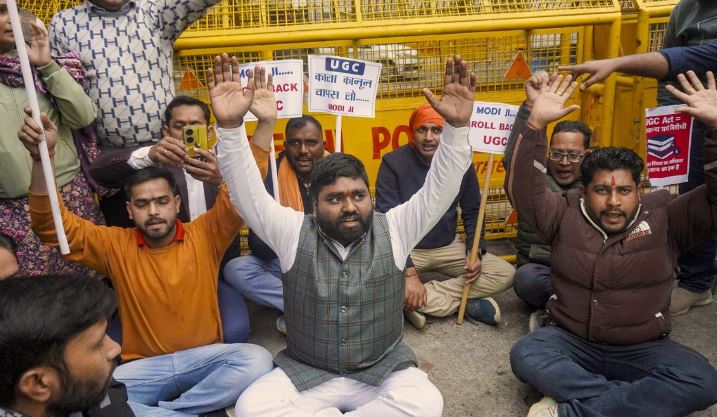
New Delhi/Bareilly(UP): The government Tuesday asserted that the new UGC regulations to check caste bias would not be “misused” and there would be no discrimination with anyone as students held protests saying these rules could lead to chaos on campuses.
Meanwhile, after the Uttar Pradesh government suspended Bareilly City Magistrate Alankar Agnihotri on charges of indiscipline following his resignation from service in protest against government policies, especially the new UGC rules, he sat on dharna at the collectorate alleging a well-planned conspiracy against him.
The new regulations mandating all higher education institutions to form “equity committees” to look into discrimination complaints and promote equity were notified January 13.
The University Grants Commission (Promotion of Equity in Higher Education Institutions) Regulations, 2026, mandated that these committees must include members of the Other Backward Classes (OBCs), the Scheduled Castes (SCs), the Scheduled Tribes (STs), persons with disabilities, and women.
The new regulations replaces the UGC (Promotion of Equity in Higher Educational Institutions) Regulations, 2012, which was largely advisory in nature.
Amid protests by students over these regulations in many states, Union Education Minister Dharmendra Pradhan assured there would be no discrimination with anyone, and the rules would not be “misused”.
“I want to humbly assure everyone, no one is going to face any harassment, there will be no discrimination and no one will have the right to misuse the regulation in the name of discrimination,” he said.
“Whether UGC, union or state government, they have the responsibility, I assure it will be within the ambit of the Constitution,” he said.
Amid heavy barricading and rain, a group of students from colleges across Delhi held a protest outside the UGC headquarters in Delhi, saying that the new regulations issued by the commission could lead to chaos on campuses.
The group submitted a list of demands to the UGC, including a complete rollback of the regulations.
“UGC officials received our submission. They agreed to discuss a few points from our list of demands,” Alokit Tripathi, a PhD student from Delhi University, told PTI.
“The UGC officials said they will consider our demand to appoint one member from the general community in the Equity Squad. Secondly, the commission assured us that it will come up with a solution within 15 days, that is, before February 12. And lastly, they said the identity of the accuser will not be kept private in order to discourage false complaints,” Tripathi claimed.
Meanwhile, Left-backed student group All India Students’ Association released a statement backing the UGC Equity Regulations, 2026. It said that inclusion of OBCs (other backward castes) within the ambit of equity protection was a welcome step.
“However, representation of SC, ST, OBC and women in the Equity Committee, both among faculties and students, remains low, vague and inadequately defined. Further, the regulations define discrimination in broad and abstract terms without enumerating concrete acts or instances of discrimination,” the statement read.
After his suspension, Agnihotri was attached to the office of the Shamli district magistrate, according to an order issued on Monday night.
The 2019-batch Provincial Civil Service officer had tendered his resignation on Republic Day citing deep disagreement with government policies. He claimed the UGC regulations could foment caste-based discontent and vitiate the academic environment.
On Tuesday, he intensified his protest against the state government and the district administration. Accompanied by his supporters, he reached the district magistrate’s office and staged a sit-in outside the premises, raising slogans against the administration.
In his resignation statement, Agnihotri had described the new UGC regulations as a “black law”.
He alleged that the rules were harming the academic atmosphere in colleges and universities and demanded their immediate withdrawal.
During the day, a plea was filed in the Supreme Court challenging the regulations, alleging the UGC has adopted a non-inclusionary definition of caste-based discrimination and excludes certain categories from institutional protection.
It urged the top court to restrain the authorities from enforcing the regulations in their current form and sought a direction to redefine caste-based discrimination in a “caste-neutral and constitutionally-compliant manner”.
The UGC document was issued after the Supreme Court told it to submit the new regulations while hearing a plea by the mothers of Rohith Vemula and Payal Tadvi, questioning the implementation of the 2012 UGC regulations.
Vemula, a PhD scholar at the University of Hyderabad, committed suicide in 2016, allegedly after being subjected to caste-based harassment. Tadvi, a resident doctor at Topiwala National Medical College and BYL Nair Hospital, killed herself in 2019, allegedly after facing casteist slurs from her seniors.
PTI