
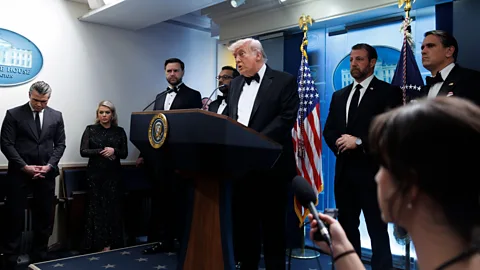
Americans must have heaved a sigh of relief that a man rushing with a gun and firing shots at the White House Correspondents’ Association dinner, where President Donald Trump, first lady Melania Trump, Vice President JD Vance and other top officials of the administration were present April 25, could not succeed in fulfilling whatever his target was. The President is safe and unhurt. Trump himself claimed, in reply to a question later, that he was the target, though investigators are yet to ascertain the motive of the attack. Trump had survived an earlier assassination attempt during a July 2024 campaign rally in Pennsylvania.
A few months later, a man tried to assassinate him while he was golfing at his golf course in West Palm Beach, Florida. Such repeated attempts on the life of the US President do not reflect well either on America’s security apparatus or on Trump himself, coming under the assassin’s radar at frightening regularity. Photographs released later of bewildered and confused-looking security personnel, with weapons drawn, show how low the American Secret Service covering the PoTUS has sunk. Trump and the first lady were seated on the stage of the cavernous Washington Hilton ballroom, playfully engaging with the evening’s entertainment. Just outside, a man sprinted through a security checkpoint with a shotgun in hand, exchanging fire with Secret Service agents who chased behind him.
Mercifully, within seconds, the gunman was grabbed and immobilised before he could reach the ballroom where the President, Trump administration officials, members of Congress and some of America’s most prominent reporters and editors were all in attendance for the annual dinner. Inside the jammed ballroom, guests had taken their seats, and within minutes, the evening took a frightening turn. The President himself was not immediately sure what had happened. Trump’s first thought was a tray full of dinner plates crashing to the floor: “I’ve heard that many times,” he would say later from the White House. Investigators are trying to ferret out information from the arrested gunman about his motive and whether he was or was not alone in the too-close-for-comfort attack. The President himself felt he was a “lone wolf,” but there is speculation whether the shooting is in any way linked to the ongoing conflict between Iran and the US and Israel. Trump was initially very cautious, ruling out any such link, but he later meaningfully suggested it could be, saying, “you never know.” The speculation on the link to the Iran crisis is only natural considering the timing of the ongoing diplomatic tensions between Washington and Tehran.
However, early findings and official remarks suggest there is no concrete evidence pointing towards foreign involvement at this stage. While authorities continue to examine all possibilities, officials have urged caution against drawing premature conclusions about international links. During a press interaction after the incident, Trump was asked whether the attack could be linked to tensions with Iran or stalled diplomatic efforts. He responded cautiously, stating, “I don’t think so. You never know. We’re going to know a lot.” While saying so, Trump iterated that his stance on Iran remains unchanged. He emphasised that the incident would not affect US strategy in the region. He asserted that it was not going to deter him from “winning the war in Iran.”
Interestingly, amid the unfolding situation, Trump also revealed that Iran had recently sent a revised proposal following the cancellation of planned negotiations. He suggested that the updated offer came shortly after he halted diplomatic efforts. According to Trump, the new proposal was an improvement on earlier terms, though he did not provide specific details. The timing of this exchange has added another layer of context to the broader geopolitical backdrop surrounding the incident. Trump explained that the decision to cancel talks was based on practical and strategic concerns. He cited extensive travel requirements and the absence of direct engagement with Iran’s top leadership as key reasons. He indicated that US representatives were not meeting decision-makers at the highest level, reducing the effectiveness of negotiations.
Instead, he suggested that future discussions could take place remotely, signalling a shift in diplomatic approach. It is clear from the drift of his Press statements that while negotiations may continue in some form, the issue of Iran’s nuclear programme remains non-negotiable. The administration continues to frame its Iran policy around this central objective. The shooting incident could be an outcome of the climate of war-mongering and arrogance shown so far by Trump and his comrade-in-arms, Israeli Prime Minister Benjamin Netanyahu, who was primarily responsible for starting the unilateral war with Iran. Hatred has been spawned by the two leaders so much that unhinged persons may take to violence with total disregard to democratic norms. This ideally should not be tolerated, but the responsibility for restoring people’s faith in the rule of law rests far more on the top leaders than on gun-toting individuals.