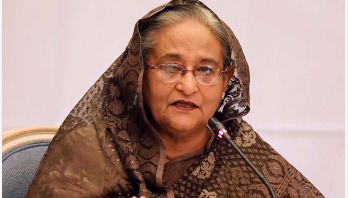
Former Bangladesh Prime Minister Sheikh Hasina’s announcement during an interview with news agency Reuters that she intends to return to her country around December, even at the cost of her arrest or death, has transformed what was largely a domestic political issue into a significant diplomatic challenge for India. Living in India since her ouster from power in August 2024, Hasina has repeatedly vowed to return. But her latest interview is different. For the first time, she has announced a tentative timeline and publicly stated that she is prepared to surrender despite the death sentence imposed against her for crimes against humanity supposedly committed by the police and military during her governance period. This judgement was passed by a tribunal set up by the temporary administration that came to govern Bangladesh after her ouster from power and fleeing to India. By this public declaration, she has placed New Delhi in an increasingly uncomfortable diplomatic position.
India can no longer afford the luxury of strategic ambiguity with regard to Hasina’s stay. For nearly a year, New Delhi has responded cautiously to Dhaka’s repeated requests for Hasina’s extradition. Officially, India has maintained that Bangladesh’s request is under legal examination, neither accepting nor rejecting it. That cautious approach may have appeared prudent when Hasina’s future intentions were uncertain. However, now that Hasina herself says she wants to return and face the courts, it becomes considerably harder for New Delhi to sustain the same approach. The reasons for New Delhi covering up Hasina at the immense cost of losing out on good relations with Bangladesh are no secret to anyone.
Also Read


The dilemma confronting India reflects the shortcomings of a foreign policy that became excessively dependent on a single political leader. During Hasina’s long tenure, India and Bangladesh enjoyed unprecedented cooperation in security, connectivity, trade, border management and specifically the purchase of power from one favored Indian industrialist. She addressed many of India’s long-standing security concerns, particularly regarding insurgent groups operating in the country’s northeast, and emerged as one of New Delhi’s closest regional partners.
Yet, foreign policy built around personalities rather than institutions is inherently fragile. The long simmering political discontent in Bangladesh that erupted out in the open in 2024 exposed precisely that weakness. The inability to read the obvious public sentiment in Bangladesh put India is a terrible situation with the lone friendly neighbour. Instead of cultivating durable relationships across Bangladesh’s political spectrum, India appeared to invest disproportionately in one government and one leader. The Indian leadership clearly failed to gauge the mood of Bangladesh’s public that had turned against Hasina for her autocratic tendencies. When Hasina’s government fell, New Delhi found itself helplessly struggling to adjust to a new political reality in its neighbourhood that was created by enemies.
The consequences are for all to see. Bilateral ties between New Delhi and Dhaka have gravely deteriorated while anti-India sentiment has found greater political space in Bangladesh. On top of this, Dhaka’s repeated demands for Hasina’s extradition has become a persistent source of diplomatic friction.
Hasina’s latest statement complicates matters further. If she genuinely intends to return voluntarily, India must decide whether it should continue to host her indefinitely or facilitate a process consistent with both domestic law and its international obligations. If, on the other hand, her declaration is primarily intended to boost the morale of her supporters ahead of Bangladesh’s local elections or to revive the political fortunes of her party, the Awami League, New Delhi must be careful not to become an unsuspecting participant in Bangladesh’s internal political fight in the long term.
Sheikh Hasina’s proposed return may or may not materialise in December. The real test of Indian diplomacy is therefore not whether Hasina returns home. It is whether India can demonstrate that its relationship with Bangladesh is ultimately anchored not in the fortunes of a single leader but in the enduring interests of two neighbouring nations.
Given the trajectory of India’s foreign policy apparatus over the last decade or so, this could be asking for too much. India has made enemies out of all its neighbours because of its flawed and short-sighted foreign policy that seems absurdly weighed down by petty business interests. India’s all-powerful northern neighbour China has virtually encircled the country with enemies on all sides. Till 2024, Bangladesh was the only country in the neighbourhood that had good ties with India. A friendly Bangladesh is crucial for India, both geographically and strategically but the future seems highly uncertain.