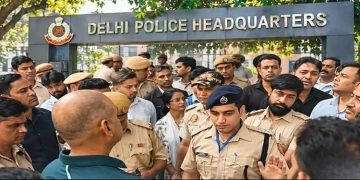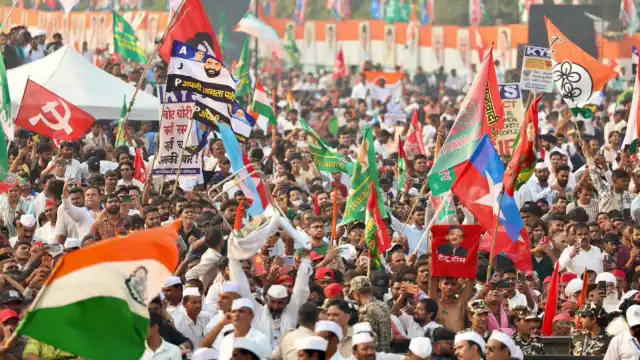
The joint Opposition rally of 1 November marks a turning point in the agitation for the removal of CEC Gyanesh Kumar, and more significantly against those seen as his political masters who have worked to enable and protect him. At this stage, the Opposition can no longer work within the framework of the EC as it stands today without risking a total loss of credibility in its agitation against the CEC. With elections due in Uttar Pradesh and four other states in early 2027, the choice is stark. Either the government finds a way to replace the CEC, at immeasurable loss of face after having defended him more than he has defended himself, or the Opposition stays away from elections conducted under him. That second option is no longer hypothetical: many voices have already called for a boycott if Kumar holds on. If the Opposition contests while denouncing the electoral process, it lends legitimacy to what it has declared compromised. If it boycotts, the elections become a farce, though one that hands the BJP a walkover, for whatever that is worth. There is no face-saving middle ground that allows for business as usual. This is a dangerous slide in terms of political engagement, and a do-or-die moment of sorts in national politics.
Either way, the government is caught in a trap of its own making, and the Opposition is locked into a fight it cannot stand down from. It need not have been this way for the government. The simplest course was to keep some distance, or even the semblance of distance, from the CEC and his largely indefensible conduct in presiding over large-scale vote deletions under the SIR of the electoral rolls. The trouble with the rolls did not begin with Kumar — the Opposition’s charges go back to the 2024 Lok Sabha and Maharashtra elections — but once smaller irregularities went through, the slope only grew more slippery. Large-scale deletions, like any large theft, have left their inevitable track marks and made the theft stand out.


With protests gathering pace, the BJP’s response has been a rerun of its old playbook: self-righteous protestation and shouting matches meant to crowd out the Opposition’s voice. But the more the BJP plays this hand, the more it is seen as one with the CEC. And the more it is seen as one with the CEC, the more questions arise about its electoral victories in the states and indeed in the 2024 Lok Sabha elections. That is what allowed the Leader of the Opposition, Rahul Gandhi, to call the last elections “illegal” at the rally, and to level the charge of treason against the CEC.
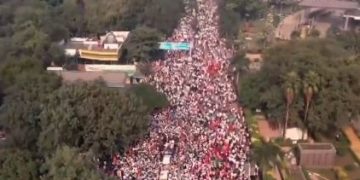
The BJP has had little to say on the central questions. Its leaders have instead questioned the size of the 1 November rally and complained that its timing disrupted Diwali shopping — a desperate search for any narrative that diverts attention from the CEC. The reality is that the rally headlined ‘Vote Bachao, Desh Bachao’ generated energy. The rally was, by most accounts, among the largest the capital has seen in recent times, and it drew people from across the country, down to a group of sadhus who marched along happily. Beyond Ramlila Maidan, the Prime Minister is being mocked, in sheer volume and in endless variety, across social media. What took ten years and untold resources to build — a carefully curated image — is collapsing at lightning pace on the issue of ‘vote chori’.
Many uncritical observers and self-seeking players once held up the megaphone mode of communication as a template for all seasons. It was clear then, and should be painfully evident now, that brute force makes for bad communications. Dominating the landscape, monopolising the conversation and overplaying the rhetoric may win headlines in the short haul; they do not build anything that lasts.
But the larger lesson is about India itself, and it is not the one many expected. A Pew Research Center survey released in early 2024 found that 85% of Indians surveyed favoured rule by a strong leader or by the military, the highest share among the 24 countries studied. Two in three backed a strong leader who could make decisions without interference from Parliament or the courts. By that measure, a strong-leader image should have been unassailable. Prime Minister Modi should be riding high. He is instead being pulled down. Why has this come to pass?
It has been argued that the Congress lost after the Emergency not because free speech and constitutional guarantees were suspended, but because of the excesses of target-driven population control and sterilisation camps. On this view, democracy matters far less to Indians than is commonly assumed. Yet the ‘vote chori’ agitation tells the story of a different India.
Indians may admire a strong hand in the abstract, if the Pew numbers are to be believed. But rights as they play out in everyday life matter. A vote is seen as an invitation to participate in the democratic process. Over the decades, electoral officers have come to the doorstep and enrolled new voters. Never before have names been struck off as easily as under the SIR. In fact, the SIR generated a sense of fear. The invitation turned into a threat. Free and fair elections matter, and while Indians may complain about the process and the quality of politicians who stand and win, they will rise to fight when the system itself is tampered with to grab and retain power.
Yet the nation must prepare for difficult times. The signs of a tightening grip are already visible: social media posts taken down, people stopped from reaching protests, heavy police deployment on the ground, and Jantar Mantar de-notified as a protest site in the middle of the agitation. Equally, the protests will not be easily silenced. What new strains will emerge, and what toll they will take on the nation, is not yet clear. But the coming together of the Opposition and the resolve of citizens to defend their vote is hope amid much gloom this festival season.
The writer is a journalist and faculty member at SPJIMR. ©The Billion Press