
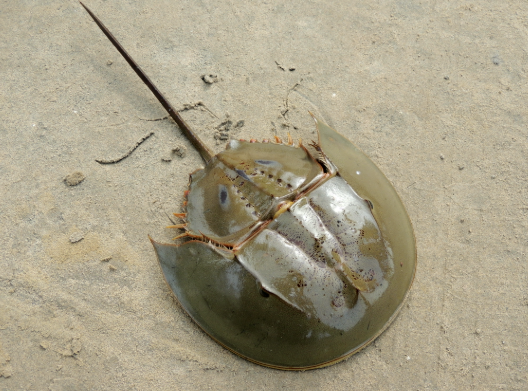
Kendrapara: Odisha’s horseshoe crab population could disappear within the next eight to 10 years unless urgent measures are taken to protect its breeding habitats, a scientist warned Friday.
In a note released ahead of International Horseshoe Crab Day June 20, former CSIR-National Institute of Oceanography scientist Anil Chatterji said the species, often described as a “living fossil” for having survived for over 450 million years, now faces a serious threat from habitat degradation and human activities.
Reflecting on nearly four decades of research, he said systematic studies on horseshoe crabs in India began in 1986 after a pharmaceutical company sought information on the species’ availability along the Indian coast.
A breakthrough came June 20, 1987, when Chatterji’s team, with the help of local fishermen, discovered a large breeding aggregation of horseshoe crabs at Balramgari near Chandipur in Balasore district. The discovery marked the beginning of organised horseshoe crab research in the country.
Subsequent studies revealed that the species’ spawning is closely synchronised with tidal height and lunar cycles, providing important insights into its breeding behaviour and habitat requirements.
Supported initially by Unichem Laboratories and later by the Department of Ocean Development, the research expanded to include migration, nesting ecology, habitat conservation and biomedical applications, he noted.
Also Read : SC refuses to accord urgent hearing on pleas related to NEET-UG 2026
Among the programme’s significant achievements was the development of a patented technique to extract horseshoe crab blood without harming the animal.
The research demonstrated India’s capability to produce amoebocyte lysate, a highly sensitive reagent used worldwide to detect bacterial endotoxins in vaccines, injectable drugs and medical devices.
Chatterji credited former chief minister Biju Patnaik for extending crucial support to horseshoe crab research in Odisha, which led to projects on artificial breeding, larval rearing and habitat conservation. He also acknowledged the contribution of late researcher Chitta Behera to the study and conservation of the species.
However, long-term studies conducted between 1988 and 2006 recorded an estimated 73 per cent decline in horseshoe crab populations along the Odisha coast, he said.
Habitat destruction, coastal development, pollution, beach modification and accidental capture in fishing nets have emerged as the principal threats.
“If the present trend continues, Odisha could lose its horseshoe crab population within the next eight to ten years,” Chatterji cautioned, adding that ecological and biomedical significance of the species makes their conservation imperative.
Instead of blanket fishing bans, Chatterji sought community-based conservation, protection of breeding habitats, public awareness and long-term scientific monitoring.
He urged the Odisha government, research institutions and young scientists to build on the state’s pioneering legacy and ensure the survival of one of the world’s oldest surviving marine species.