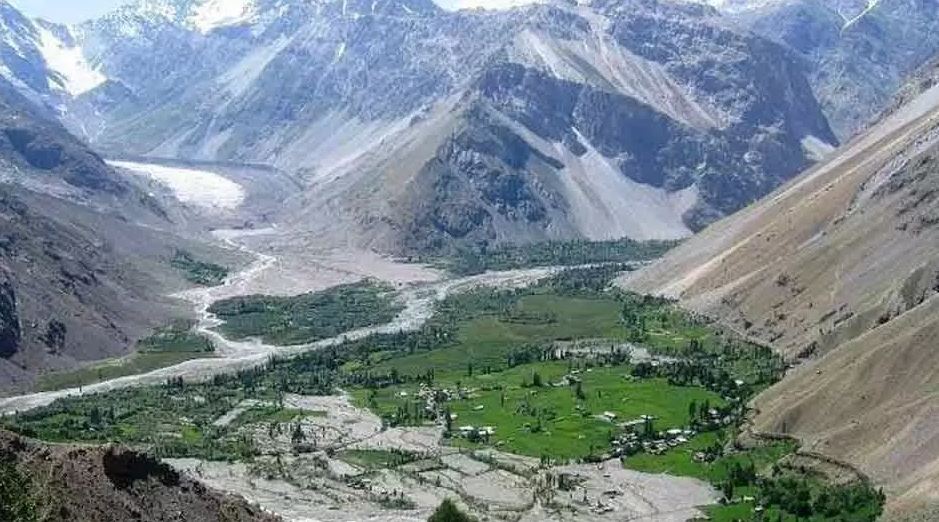
New Delhi/Washington: Since it occupied Gilgit-Baltistan (G-B), the Shia-dominated region of the erstwhile state of Jammu and Kashmir, Pakistan has altered its demography, resulting in the massive reduction of the Shia population from 80 to 39 per cent.
In a recent study conducted by the Law and Society Alliance, a New Delhi-based think tank headed by N.C. Bipindra, the population of G-B is now approximately 1.5 million, with around 39 per cent Shia, 27 per cent Sunni, 18 per cent Ismaili and 16 per cent Nurbakhshi.


Earlier, the region was dominantly inhabited by Shia Muslims with a share of 80 per cent. As per the last census held in 1998, the population of G-B was around 870,000. Once, one of the most multi-ethnic, multicultural, and multi-linguist regions of the world, G-B in the last seven decades has however faced severe persecution from the Pakistani Army.
The report, titled ‘Human Lives Matter: A Comparative Study and Analysis of Human Development and Human Rights in J&K and PoJK/G-B’, said that the most severe damage to the culture and ethnicity of the region occurred in 1988, when militants supported by the Pakistani military and Federal Minister for Kashmir Affairs, launched attacks in the region and killed hundreds of people.
Known as ‘The Gilgit Massacre’, it lasted for 16 days with continuous bloodshed, burning of more than 14 villages and molestation of local women.
“People were burnt alive in their homes – not for their fault, but for their faith,” the report said, adding that till 2013, around 3,000 Shias were massacred by the state-sponsored Sunni extremists in G-B.
A report of the International Human Rights Observer’s (IHRO) G-B chapter, released in 2013, stated that around 3,000 people have been killed in sectarian violence since 1988. On the loss of lives and its impact, it stated that about 900 women have been widowed and nearly 2,500 children orphaned.
The report mentioned “the loss to property is inestimable”.
On August 16, 2012, in an act of ‘targeted genocide’ of Shia Muslims in G-B, over a dozen gunmen forced 19 passengers, mostly Shias, off four buses and shot them at point-blank range. It was the third such incident in six months, only to be followed by many more similar occurances.
In one incident, 18 Shia pilgrims were openly killed on the Karakoram Highway in Kohistan district while returning from Iran on February 28, 2012. Another brutal attack claimed the lives of 20 people at Chilas on April 3 that year.
The Shias, in general, have been the subjects of attack across Pakistan.
Shias of the G-B region are targeted and killed across the country. In the aftermath of violence that occurred in Gilgit and Chilas, two Shias from G-B were shot dead in Quetta on April 3 and Ahmer Abbas, a Shia student from G-B, was shot dead in Karachi on April 6, 2012.
In a protest against the targeted killings, Majlis-i-Wahadatul Muslimeen (MWM) Deputy General Secretary Allama Asghar Askari said, “The entire Shia community has been deeply shocked by the unending spate of targeted killings.
“The government seems to be concerned over peacocks dying in Sindh but gives no importance to people mercilessly killed by extremists.”
Besides numerous violent attempts of ethnic cleansing in these regions, the Pakistan government and military, under the leadership of Zia-ul-Haq, made several continuous attempts to alter the ethnic demography of the region, the report said.
Post 1980s, Sunni Muslims from hegemonic Pakistani provinces like Punjab and Khyber Pakhtunkhwa started to make an influx through business routes and started to gradually settle in the region.
Researcher and activist Samuel Baid points out that “the influx of outsiders has created two problems, depletion of employment opportunities for the locals and brutalisation of sectarian tension. The outsiders grab land and government jobs. It is not only the jobs that the outsiders grab, but they also plunder upon forest and natural resources in the region. The funds allocated for the development of G-B are spent on the Army deployed there”.
Terror camps that were being run in G-B openly with the active support of the Pakistani Army have bred hundreds of Sunni Jihadis of the Sipah-e-Sahaba Pakistan (SSP), who are now operating all across the region, killing Shia Muslims.
Rebutting the Pakistani government’s claims that foreign forces are involved in the G-B riots, Inspector General of G-B, Hussain Asghar went on record to say: “I don’t think there is any foreign hand involved in sectarian riots.”
It is not only that the Shia, Ismaili and Nurabakhshi communities have been the targets of sectarian violence and ethnic cleansing in Pakistan, rather, the liberal Sunni Muslims have also been victims of attempts of Pakistani government and Army to cleanse the region and populate it with staunch Sunni Muslims, the study said.
Inhabitants of G-B for several years, have been voicing their concern that their region is under Taliban attack from the Waziristan region and being used as safe havens for jihadis, supported by the Salafi elements in the Pakistan Army.
At the 13th session of the UNHuman Rights Council, Abdul Hamid Khan of the Balwaristan National Front said: “Human rights abuses are widespread and common in G-B for many decades but the absence of local media and independent judiciary have helped Islamabad to hide its illicit practices.”
The abolishment of the State Subject Rule in G-B in 1974 and introduction of the Gilgit-Baltistan Empowerment and Self-governance Order in 2009 snatched land rights from G-B locals and opened the door for Pakistani settlements in the region.
The Pakistani elites, including several Corporate, Army Generals and politicians have acquired land and built sprawling residences in G-B. The list includes Prime Minister Imran Khan, former President Parvez Musharraf, Senator Talha Mahmood and Hamid Gul, as well as many others.
Many Chinese citizens, who initially came to work on China-Pakistan Economic Corridor (CPEC), have now settled all across G-B. A 2010 Stratfor report estimated the figures and claimed that 7,000 to 11,000 PLA soldiers guard CPEC projects. The number is expected to multiply manifold in a decade.
Several radical Pakistani musclemen, including former Army officers, are being roped-in to work on projects of CPEC. These Wahhabi Sunni workers permanently settle in G-B, further radicalising the region and wiping out the Shia majority.
The Federal government of Pakistan has also been working to alter the demography of PoJK, since as early as 1971.
In an article written in 1971, titled ‘Azad Kashmir: A Colony of Islamic Republic of Pakistan’, Convenor of United Kashmir Liberation Front, the UK-based M. Bashir Asef presented details on the attempts made by Pakistan to colonise PoJK.
It highlighted that through institutional; and non-institutional moves, the Pakistani government was easily facilitating the settlement of non-Kashmiris in PoJK since before.
The Pakistan government prefers to award contracts of projects in PoJK to Army of the local work force and later settle in the region. The labourers are deprived of labour rights, as they are barred from making labour unions. The obvious reason behind facilitating settlement of Army personnel in PoJK is to ensure a dominating position along the Line of Control (LoC) in case of confrontation with India.
Besides targeted attacks on Shias of the G-B, Pakistan government has also been making continuous efforts to ensure ethnic cleansing of Shia Muslims in PoJK.
According to a database compiled and maintained by media organisation LUBP, there have been around half-a-dozen organised attacks on the Shia community in PoJK, leading to innumerable casualties.
The attacks were precisely targeted at Shia areas and in a couple of incidents, on Shia processions and most of them were carried out collectively by large groups of Sunni Muslims, the study said.