
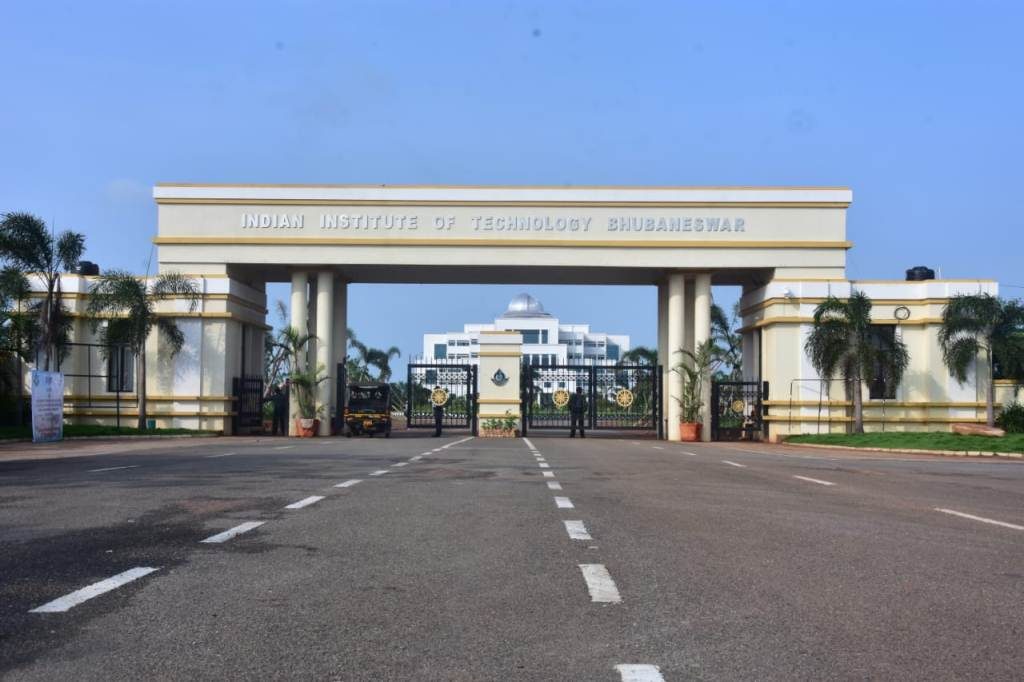
Bhubaneswar: A new research study by an IIT Bhubaneswar scientist has identified a promising semiconductor surface that could pave the way for the development of next-generation electronic devices capable of processing and storing information using electron spin, potentially enabling faster and more energy-efficient technologies.
The study, led by Dr. Manish Kumar Mohanta, Ramanujan Faculty in the Department of Physics at the Indian Institute of Technology (IIT) Bhubaneswar, identifies the (110) surface of cubic zinc-blende silver iodide (AgI) as a promising platform for hosting a quantum phenomenon known as Persistent Spin Texture (PST).
The findings have been published in Physical Review B, a leading international journal in condensed-matter physics published by the American Physical Society.
Electrons possess an intrinsic property called spin, which, in addition to their electric charge, can be used to carry and process information. In certain nonmagnetic semiconductors, electron spins exhibit a remarkably stable and unidirectional alignment, known as Persistent Spin Texture (PST).
This property is particularly significant for the emerging field of spintronics, which seeks to harness electron spin for information processing and storage. Materials exhibiting PST are considered promising candidates for future electronic technologies because their stable spin arrangements can suppress unwanted spin relaxation and help preserve spin information for longer periods.
Using first-principles quantum mechanical simulations supported by mathematical models, Dr. Mohanta demonstrated that the (110) surface of silver iodide exhibits a unidirectional spin pattern, making it a potential candidate for future spintronic applications.
The study further reveals that this spin texture remains stable under moderate mechanical strain. However, an electric field applied perpendicular to the surface can disrupt the spin arrangement, indicating the possibility of electrically manipulating the spin texture. This feature could be important for developing devices in which spin-based information can be controlled through external electrical signals.
In addition to the findings on silver iodide, the research introduces two new mathematical models to explain the unusual spin patterns observed in the bulk semiconductor OsSi. It also addresses a fundamental scientific question: Can a nonmagnetic bulk semiconductor exhibit a unidirectional spin pattern similar to that observed in two-dimensional materials?
The development of these mathematical models represents an important contribution to understanding electron spin behaviour in quantum materials. They provide new approaches to describing, interpreting and predicting spin patterns, potentially opening further avenues for identifying materials suitable for advanced spintronic technologies.
For Dr. Mohanta, the publication also marks an important milestone as his first independent research work since joining IIT Bhubaneswar as a Ramanujan Faculty member.
The findings strengthen the theoretical understanding of spin behaviour in nonmagnetic semiconductors and provide a foundation for further exploration of materials that could enable more efficient, spin-based electronic devices in the future.