
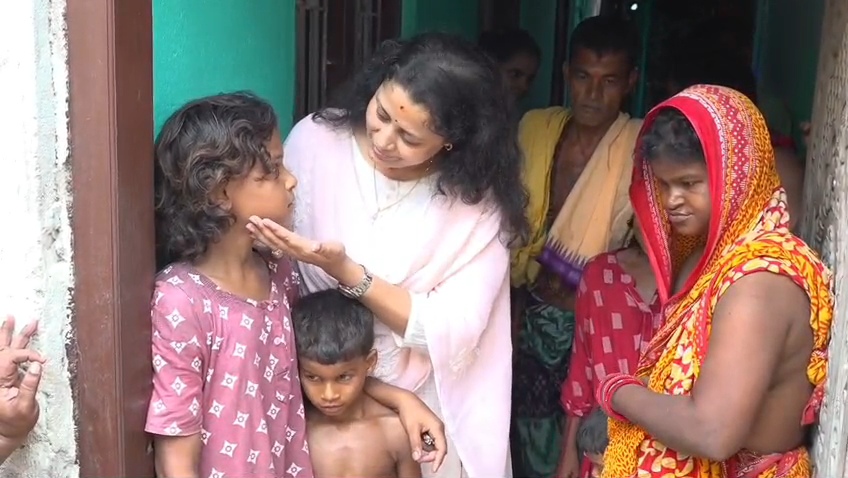
Puri: In a world often too hurried to notice silent suffering, even a small act of compassion can become a lifeline for the people in need, exactly like the life of a homeless mother and her four young children in Puri’s Satyabadi. For years, life had offered little more than hardship to the destitute family of Sumati.
Outside the revered Baba Balunkeswar Temple in Barala, the mother and her children could be seen each day seeking alms from devotees and passersby. Beneath the sacred shadow of the temple, their lives unfolded in painful uncertainty—without shelter, security, or hope of a better future.
The children, who should have been carrying school bags and chasing dreams, instead carried the burden of survival. Sumati says she hails from Nayagarh but has no one of her own now. Abandoned by her husband and left with no means of livelihood, she came to the religious site few years ago and turned to begging as the only way to feed her children.
On some nights, the family used to find temporary refuge on a mandap verandah beside a pond dedicated to the temple. On other nights, they would sleep on the verandahs of houses belonging to the villagers or temple servants. Scorching summers, relentless monsoons, and bitter winter nights made little difference; the open sky was often their only roof.
While their struggle was visible to hundreds of people every day, Bhubaneswar-based social activist Kavyapriya Dhal encountered the family at the shrine and was deeply moved by their plight. She chose to become a part of their journey. “What I saw was not just poverty,” she recalls. “I saw four children standing at the crossroads between a life of deprivation and the possibility of a better future.
That thought stayed with me.” Dhal immediately began efforts to rehabilitate the fam ily. She arranged safe accommodation for the mother and her children in the home of a temple servitor, ensuring they would no longer have to sleep in the open. She provided food, clothing, and other essential necessities while also initiating efforts to secure educational opportunities for the children.
Most importantly, she restored something poverty had nearly taken away—their dignity. For the children, the change is already visible. Faces once marked by uncertainty and fear now carry glimpses of confidence and hope. Subash Mohapatra, a servant of the temple, said, “Thousands of devotees come to this sacred shrine every year seeking blessings and fulfilment of hope because Baba Balunkeswar is Shiva in the form of Kamana Lingam, one who fulfils all prayers.”
“This family had been surviving here for more than two years on whatever devotees and residents could offer. But theirs was a life without digni ty or security. I never imagined they would see such a new beginning,” Mohapatra added. The help Sumati’s family received offers a powerful example of what individual action can achieve.
While governments, welfare programmes, and civil society organisations play indispensable roles in social development, meaningful change often begins when ordinary citizens choose responsibility over indifference. Significantly, this is the land of Utkalmani Gopabandhu Das, whose lifelong commitment to public service and humanitarian values continues to inspire generations of Odias.
In that spirit, Kavyapriya’s act of compassion stands as a reminder that service to humanity remains one of society’s highest virtues.