
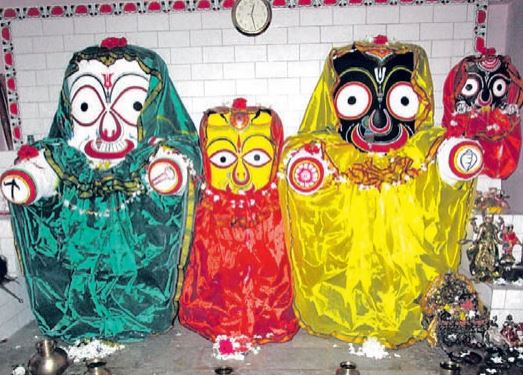
Kendrapada: Tucked away at Habeli (Pati Sahi), about 12 km from Kendrapada town and 1.5 km from Indupur market, stands a nearly 300-year-old Shri Jagannath Temple that continues to preserve unique traditions and historical mysteries.
Home to the Chaturdha Murti of Lord Jagannath, Lord Balabhadra, Devi Subhadra and Sudarshan, the shrine has become a subject of growing interest among historians and researchers because of its ancient chakasanas and centuries-old customs.
The wooden deities are seated on three chakasanas (pedestals) and, unlike at the Jagannath Temple in Puri, they never undergo Nabakalebara, the ritual renewal of the deities.
However, almost every other ritual associated with Jagannath culture is observed here.
The temple’s most distinctive tradition is that instead of being taken out in a chariot procession, the deities are ceremonially seated on chakasanas within the temple premises during Rath Yatra.
According to retired teacher and temple servitor Nilamadhab Pati, Rath Yatra has not been celebrated with a chariot here for more than 300 years.
He believes the practice was discontinued because the village lacks a traditional Bada Danda (grand avenue) and a Mausima temple.
Pati said the present temple structure dates back nearly three centuries, although the original shrine is believed to have stood on the banks of the Birupa River.
He said evidence found at different times suggests the existence of a 12th-century temple at the site.
A stone slab was reportedly unearthed by a villager while digging the foundation for a house near the river embankment, lending support to the belief that an older shrine once existed there.
Local folklore surrounding the temple has also endured for generations.
Residents speak of three wells believed to have disappeared in the Birupa River.
It is widely believed that during the invasion of Mughal emperor Aurangzeb’s forces, large quantities of gold and silver ornaments, along with other valuables belonging to the temple, were concealed inside these wells to protect them from plunder.
While no historical evidence has confirmed the belief, it continues to form an important part of the area’s oral tradition.
Another feature that has attracted scholars is the ancient chakasanas on which the deities are seated.
Pati said the idols are about four feet tall and the pedestals bear inscriptions in an early script that are yet to be deciphered.
He believes the inscriptions could provide valuable insights into the temple’s history once they are studied by historians and epigraphists.
Educationist Pranab Prakash Jena said some researchers from Puri had claimed that Subhadra’s chakasana might have originated from the Srimandir, though it requires detailed research and historical verification before coming to any conclusion.
Chandan Kumar Sahu, a local devotee, said the shrine is older than Shri Baladevjew Temple at Ichhapur in Kendrapada town.
He noted that cement plaster and marble had been added to protect the ageing stone structure.
In some portions of the temple, older sculptures of deities and subsidiary deities have been exposed for better observation by devotees.
Despite its unique tradition, historical significance and archaeological potential, the temple remains largely unknown outside the region.
Sahu expressed concern that the absence of proper publicity and heritage promotion has left the ancient shrine neglected, while calling for larger efforts to preserve and document its rich legacy.