Muscat: Traditionally-built stitched ship INSV Kaundinya reached the shores of Muscat Wednesday after a 17-day maiden overseas voyage from the coastal city of Porbandar in Gujarat, a completion of the challenging expedition that marked a symbolic revival of the arc of ancient maritime times between India and Oman.
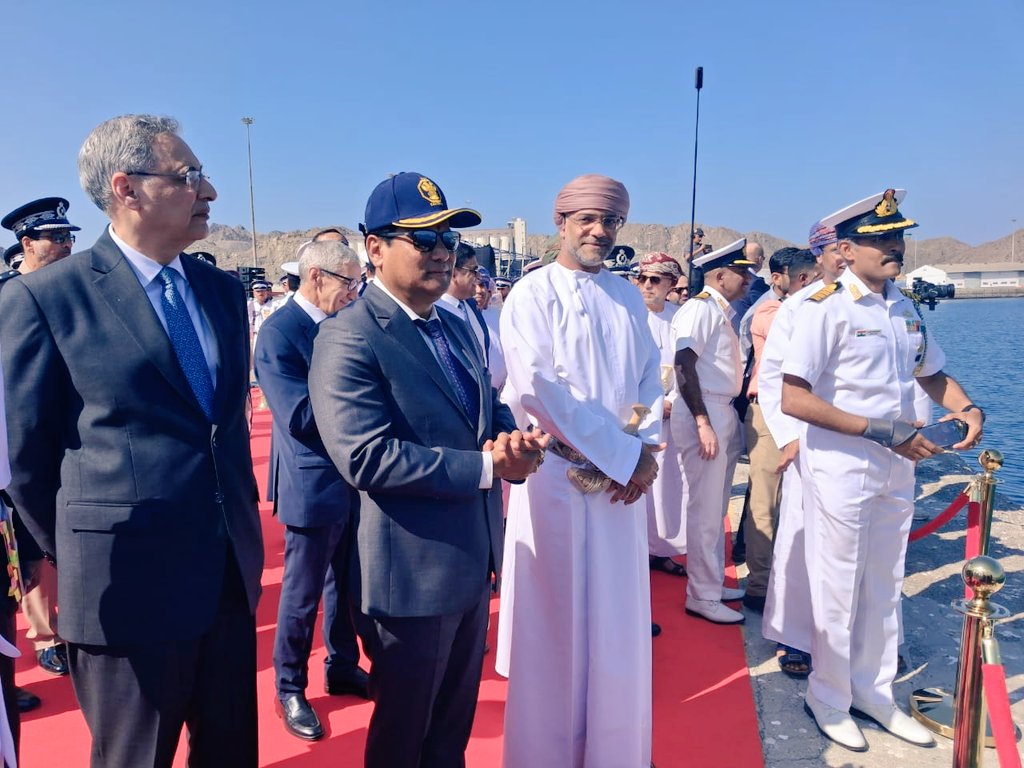
The crew, comprising four officers and 13 naval sailors led by Commander Vikas Sheoran, was accorded a rousing welcome on arrival at a ceremony that was also attended by Union Minister of Ports, Shipping and Waterways Sarbananda Sonowal, senior officials of the Indian Embassy in Muscat and Oman’s Ministry of Heritage and Tourism and Royal Navy of Oman.


The 65-foot-long vessel has been constructed using traditional stitched shipbuilding techniques, employing natural materials and methods that date back several centuries.
The ship is a recreation of a fifth-century vessel and is inspired by a painting from the ancient Ajanta Caves.
Named after the legendary mariner Kaundinya, who is believed to have sailed from India to Southeast Asia in ancient times, the ship embodies India’s historic role as a maritime nation.
This expedition recalled the history, heritage and power of India in the maritime sector. The crew has made India proud, and this voyage has also strengthened our centuries-old ties with Oman… Long live India-Oman friendship, Sonowal, who received the crew at Port Sultan Qaboos in Muscat, told reporters here.
Azzan bin Qassim Al Busaidi, Undersecretary of Oman’s Ministry of Heritage and Tourism, was also present on the occasion.
This (project) is also to show that ancient India, which we are very proud of, was really based on risk-takers, adventurers, merchants who went out, discovered new markets and new lands, spread culture, but also imbibed new ideas from them; and, sort of explored this Indian Ocean world, thousands of years ago. So in some ways we are just following their footsteps, Economic Advisory Council member Sanjeev Sanyal, who was on board the ship, told PTI here.
So, ancient India was a country of risk-takers, and that is what we are really celebrating here, he said.
December 29, the ship had set off on her maiden overseas voyage, from Porbandar to Muscat.
The voyage retraces ancient maritime routes that once connected the western coast of India with Oman, facilitating trade, cultural exchange, and sustained civilisational interactions across the Indian Ocean, a Navy spokesperson then said as it had embarked on a landmark expedition.
The project of building a stitched ship with an ancient technique was initiated through a tripartite agreement signed in July 2023 between the Ministry of Culture, the Indian Navy, and Hodi Innovations, with funding from the Ministry of Culture.
The voyage retraces ancient maritime routes that once connected the western coast of India with Oman, facilitating trade, cultural exchange, and sustained civilisational interactions across the Indian Ocean.
Commander Y Hemant Kumar, officer-in-charge of the expedition, who is associated with the project, said he felt proud and ecstatic as the ship hit the shores of Muscat, marking the completion of an eventful journey.
The experience of sailing has been exhilarating, and it was very adventurous, he told PTI here.
The naval officer said it is no mean task to sail on a transoceanic voyage from Porbandar to Muscat.
The distance is about 650 nautical miles. The Indian Navy trained us very well for this expedition. And it was a one of a kind of experience, he said.
Asked about the challenges in designing the ship, Commander Kumar said that the project was on the other end of the spectrum.
As you are aware, the Indian Navy has been constructing state-of-the-art warships… from aircraft carriers to submarines. But, this was on the other end of the spectrum, as a 5th-century Ajanta painting (was a reference point).
It is, mind you, just a painting, an artistic impression. It is not even a blueprint which had dimensions. This does not have dimensions, so we had to extrapolate from that painting into an actual functional warship, he said.
It was an immense challenge. And sailing it, equally, had other immense challenges, the naval officer said.
There is no nail on the ship, and the joining technique has been purely on stitching and traditional artisans from Kerala have done it. So, as you can see, the ship is safe here, and it could withstand the loads of the ocean, he added.
The Indian Embassy here said the Indian Naval Sailing Vessel (INSV) Kaundinya successfully completed its maiden voyage from Porbandar and arrived in Muscat today.
The voyage of this traditionally built stitched sail vessel stands as a powerful symbol of the deep-rooted maritime, cultural, and civilisational ties spanning over 5,000 years between India and Oman, it said in a statement.
It also highlights the fact that oceans are connective corridors rather than barriers, enabling sustained interaction between the two nations. The expedition assumes special significance as the two nations celebrate 70 years of establishment of diplomatic relations, the embassy said.
A large Indian community from all walks of life, including students, enthusiastically welcomed the ship.
Traditional Indian and Omani cultural performances were held during the official welcome of the ship.
From the commencement of construction in September 2023 to its induction into the Indian Navy in May 2025, the initiative successfully revived a nearly extinct shipbuilding tradition.
Looking ahead, India and Oman are expanding maritime cooperation anchored in enhanced connectivity, secure sea-lines of communication, and emerging opportunities in the blue economy, it said.