
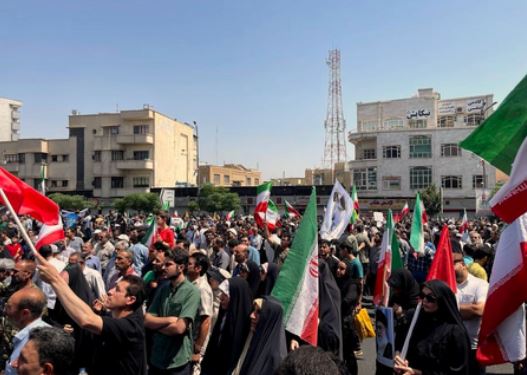
Dubai: Iran’s bloody crackdown on nationwide protests killed at least 6,126 people while many others are feared dead, activists said Tuesday, as a US aircraft carrier group arrived in the Middle East to lead any American military response to the crisis.
Iran’s currency, the rial, meanwhile, fell to a record low of 1.5 million to USD 1.
The arrival of the USS Abraham Lincoln aircraft carrier and guided missile destroyers accompanying it provides the US the ability to strike Iran, particularly as Gulf Arab states have signalled they want to stay out of any attack despite hosting American military personnel.
Two Iranian-backed militias in the Mideast have signalled their willingness to launch new attacks, likely trying to back Iran after US President Donald Trump threatened military action over the killing of peaceful protesters or Tehran launching mass executions in the wake of the demonstrations.
Iran has repeatedly threatened to drag the entire Mideast into a war, though its air defences and military are still reeling after the June war launched by Israel against the country. But the pressure on its economy may spark new unrest as everyday goods slowly go out of reach of its people.
Activists offer new death toll
The new figures Tuesday came from the US-based Human Rights Activists News Agency, which has been accurate in multiple rounds of unrest in Iran. The group verifies each death with a network of activists on the ground in Iran.
It identified the dead as including at least 5,777 protesters, 214 government-affiliated forces, 86 children and 49 civilians who weren’t demonstrating. The crackdown has seen over 41,800 arrests, it added.
The Associated Press has been unable to independently assess the death toll given authorities have cut off the internet and disrupted calls into the Islamic Republic.
Iran’s government has put the death toll at a far lower 3,117, saying 2,427 were civilians and security forces, and labelled the rest “terrorists.” In the past, Iran’s theocracy has undercounted or not reported fatalities from unrest.
That death toll exceeds that of any other round of protest or unrest there in decades, and recalls the chaos surrounding Iran’s 1979 Islamic Revolution.
The protests in Iran began on December 28, sparked by the fall of the Iranian currency, the rial, and quickly spread across the country. They were met by a violent crackdown by Iran’s theocracy, the scale of which is only starting to become clear as the country has faced more than two weeks of internet blackout – the most comprehensive in its history.
Iran’s UN ambassador told a UN Security Council meeting late Monday that Trump’s repeated threats to use military force against the country “are neither ambiguous nor misinterpreted.” Amir Saeid Iravani also repeated allegations that the US leader incited violence by “armed terrorist groups” supported by the United States and Israel, but gave no evidence to support his claims.
Iranian state media has tried to accuse forces abroad for the protests as the theocracy remains broadly unable to address the country’s ailing economy, which is still squeezed by international sanctions, particularly over its nuclear program.
On Tuesday, exchange shops offered the record-low rial-to-dollar rate in Tehran.
Already, Iran has vastly limited its subsidised currency rates to cut down on corruption. It also offered the equivalent of USD 7 a month to most people in the country to cover rising costs. However, Iran’s people have seen the rial fall from 32,000 to USD 1 just a decade ago, which has devoured the value of their savings.
Some Iranian-backed militias suggest willingness to fight
Iran projected its power across the Mideast through the “Axis of Resistance,” a network of proxy militant groups in Gaza, Lebanon, Yemen, Syria and Iraq, and other places. It was also seen as a defensive buffer, intended to keep conflict away from Iranian borders. But it has collapsed after Israel targeted Hamas, Hezbollah in Lebanon and others during the Gaza war. Meanwhile, rebels in 2024 overthrew Syria’s Bashar Assad after a years-long, bloody war in which Iran backed his rule.
Yemen’s Houthi rebels, backed by Iran, have repeatedly warned they could resume fire if needed on shipping in the Red Sea, releasing old footage of a previous attack Monday. Ahmad “Abu Hussein” al-Hamidawi, the leader of Iraq’s Kataib Hezbollah militia, warned “the enemies that the war on the (Islamic) Republic will not be a picnic; rather, you will taste the bitterest forms of death, and nothing will remain of you in our region.”
The Lebanese militant group Hezbollah, one of Iran’s staunchest allies, refused to say how it planned to react in the case of a possible attack.
“During the past two months, several parties have asked me a clear and frank question: If Israel and America go to war against Iran, will Hezbollah intervene or not?” Hezbollah leader Sheikh Naim Kassem said in a video address.
He said the group is preparing for “possible aggression and is determined to defend” against it. But as to how it would act, he said, “these details will be determined by the battle and we will determine them according to the interests that are present.