
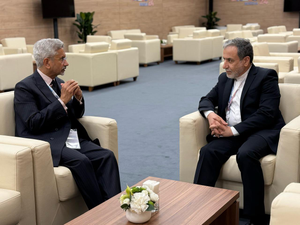
New Delhi: External Affairs Minister (EAM) S Jaishankar Friday held another telephonic conversation with Iranian Foreign Minister Seyed Abbas Araghchi, discussing bilateral cooperation and matters concerning BRICS, where India is the current chair and Iran a member of the grouping.
This marked the fourth such conversation between the two ministers amid the escalating crisis involving Iran, the United States, and Israel.
The interaction followed Prime Minister Narendra Modi’s conversation with Iranian President Masoud Pezeshkian Thursday night to review the serious situation unfolding in the West Asian region.
Taking to social media platform X Friday, EAM Jaishankar said, “Had another conversation with Iranian FM Seyed Abbas Araghchi yesterday night. Discussed bilateral matters as well as BRICS-related issues.”
According to the Iranian Foreign Ministry, Araghchi briefed EAM Jaishankar on the latest situation resulting from the “acts of aggression and atrocities” committed by the United States and the Israeli regime against Iran, as well as the consequences for regional and global stability and security.
“He emphasised the firm resolve of the Iranian government, nation, and armed forces to exercise their legitimate right to self-defence against the aggressors. The Iranian Foreign Minister stressed the necessity for regional and international bodies and organisations to condemn the military aggression against Iran. Highlighting the importance and position of BRICS as a forum for developing multilateral cooperation, Araghchi deemed it essential for the institution to play a constructive role at the current juncture in supporting regional and global stability and security,” read a statement issued by Iran’s Foreign Ministry Friday afternoon after the phone call between both ministers.
“During the call, India’s Foreign Minister expressed his country’s readiness to expand bilateral and multilateral cooperation within regional and international forums. He also emphasised the importance of finding a path to strengthen sustainable stability and security in the region as a collective necessity,” it added.
During his conversation with Iranian President Masoud Pezeshkian late Thursday evening, PM Modi had voiced concern over the escalation of tensions, pointing to the loss of civilian lives and damage to infrastructure.
He underlined that the safety of Indian nationals remains the government’s foremost priority while reiterating India’s commitment to peace and stability in the region.
“Had a conversation with Iranian President Masoud Pezeshkian to discuss the serious situation in the region. Expressed deep concern over the escalation of tensions and the loss of civilian lives, as well as damage to civilian infrastructure. The safety and security of Indian nationals, along with the need for unhindered transit of goods and energy, remain India’s top priorities. Reiterated India’s commitment to peace and stability and urged for dialogue and diplomacy,” PM Modi posted on X.
The Ministry of External Affairs (MEA) Thursday highlighted that Prime Minister Narendra Modi had reached out to several Gulf leaders following the outbreak of the conflict, stressing the importance of dialogue and diplomacy to restore peace and safeguard civilians.
“Our Prime Minister, as you know, has spoken to several leaders in the Gulf after the conflict started. In these conversations, he stressed the need for dialogue and diplomacy so that early peace can return. He also underlined the need to avoid civilian casualties, and he focused on the priority for the protection of civilians,” MEA spokesperson Randhir Jaiswal said during a weekly media briefing in New Delhi.
“We have a large Indian community in the GCC countries, and obviously, their security and welfare are of utmost importance; this was highlighted. We also, in several cases, condemned the violation of the sovereignty and territorial integrity of states,” he added.
Responding to a question regarding the movement of vessels around the Strait of Hormuz, the MEA spokesperson said that EAM Jaishankar and the Foreign Minister of Iran have discussed issues pertaining to the safety of shipping and India’s energy security.
The conversation indicates India’s proactive diplomatic outreach in light of the evolving situation.
Iran recently allowed India-flagged tankers to pass through the Strait of Hormuz following talks between EAM Jaishankar and Araghchi, with the aim of keeping the critical sea route open for the transportation of crude oil and natural gas.
According to sources familiar with the developments, Indian tankers ‘Pushpak’ and ‘Parimal’ passed safely through the Strait of Hormuz even as ships from the US, Europe and Israel continue to face restrictions in the strategically important waterway.