
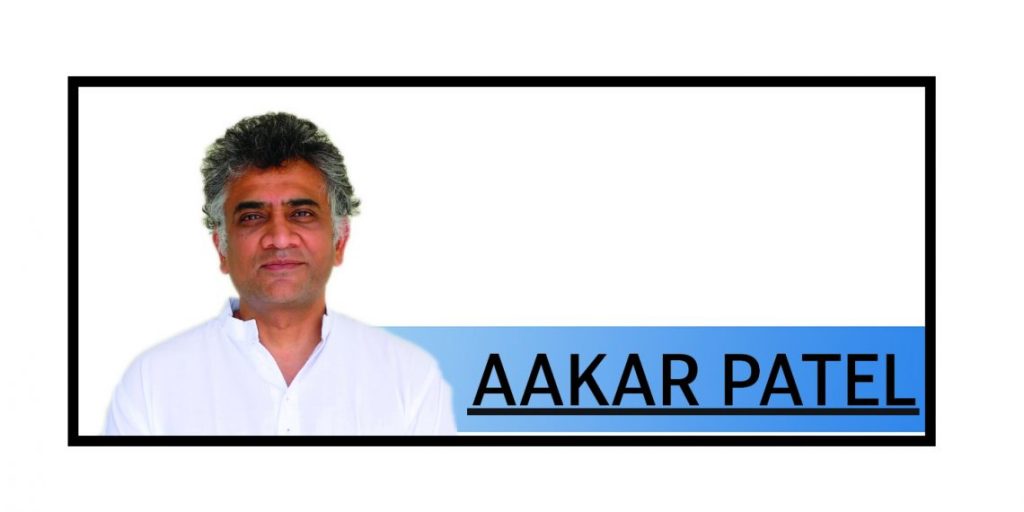
By Aakar Patel
Friend Ram Madhav has written a fine piece on Prime Minister Narendra Modi reaching an important milestone. On June 10, he writes, Modi completes 4,399 days in office uninterruptedly as Prime Minister, overtaking Jawaharlal Nehru’s record of 4,398 days.
The awkward word “uninterruptedly” is used because Indira Gandhi was in office for almost 6,000 days. No doubt our leader will cross that number in time as well. What is more interesting here is Madhav’s assertion that “Modi, undoubtedly, will be remembered as the most effective and successful prime minister of India.” His reason for this is that Modi is midway through his third term as Prime Minister. Yet, his dominance over the Indian political landscape remains towering and unchallenged. He is certain to break more records as he continues to lead the country for many years to come.
Yes, longevity is important, and staying on the crease for an extended period is also important to some people. But from the audience’s perspective, what is relevant is what is on the scoreboard. Here, the problem is that, unlike longevity, the data is unclear. Madhav says among Modi’s achievements is that India’s GDP doubled over the last decade. But it has doubled each decade since independence—certainly it has since 1960 (which is the period from which we have World Bank data). What else? Madhav says that “in foreign policy, Modi scripted a glorious history.” How? That we do not know.
Looking around us at what is happening in the world today, it would be difficult not to conclude that India is irrelevant, and the accusation can be accurately made that it is often servile—especially to US President Trump. However, we need not go there today.
The question to ask is this: How will he be remembered six decades after he is gone? In the India of 2086, what will people be writing and speaking of regarding Modi, the way we speak and write of Nehru today, 62 years after his passing? My concern is that we (those of us who are still around then and those who are born from here on) may not be referring to him at all. One reason for this is that things, people, and events that are current fade very quickly with time. Gavaskar gives way to Tendulkar, who gives way to Kohli, who gives way to Vaibhav. There is always a shiny new thing on offer, and the relationship that the present generation has with current stars is always fresher and more intense than the one they have with things of the past.
But if this is true, then why has Nehru not faded, and why are Madhav and those of us who are fans of this Prime Minister still exhuming the old Jawaharlal so long after he has gone into the ether?
That brings us to the second reason why Nehru is still with us in spirit. It is because of what he left behind. The first is institutions of every sort—educational, scientific, cultural, medical—that he conceived and built. It is rare in the world, and especially rare in our parts, to see such an achievement. Compare the legion of things Nehru built with what Modi has conceived and executed. One is hard-pressed to come up with any. Perhaps the hapless NITI Aayog (is it still around?) might be one thing Modi gifts to the India of the future, but what else? It is hard to say.
The second thing Nehru left behind is, like his institutions, still around us and associated with him: what is called the “idea of India.” Meaning, a pluralist society that has a pathway to modernity. Here, we can concede that Modi has made a difference and parted ways with the past in a way that may be longer lasting than his non-existent institutions. Madhav concludes by writing that “it is not just the numbers that distinguish Modi from others. It is the quality of governance, ideological vision and effective development agenda that he brought to the table as the leader of the world’s largest democracy that makes him the shining star of Indian politics.”
This India around us that has made him the shining star is one dominated by laws and policies of exclusion and persecution. Bulldozers, lynchings, special intensive revisions, and so on. And on. Much of it is not new, of course, but the intensity is new, and it is his gift to India.
One is not sure whether what we have experienced will last till 2086. One hopes it does not, but then, it is irrelevant for me because I will not be around to see it. My guess, which is based on the evidence of what has been left behind in the last dozen years, is that if this continues for another decade or so, let alone another six decades, he will indeed be remembered—but not for the reasons Madhav would like him to be.