
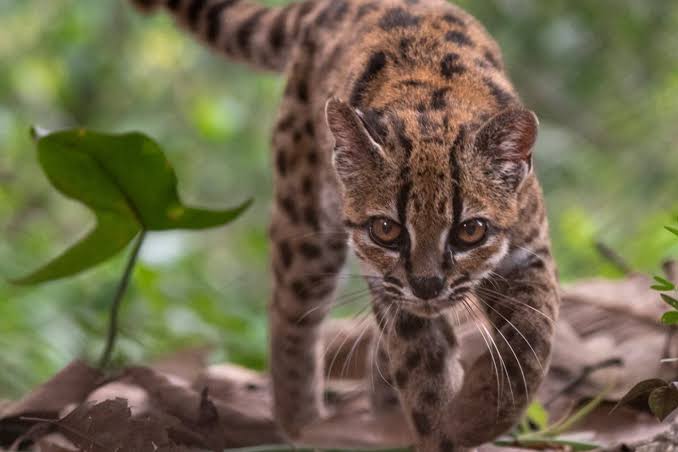
La Paz: A diminutive wild cat that inhabits Bolivia’s cloud forest has been identified as a previously unknown species, marking the first time a new living cat species has been formally named and described in more than a century.
The cat, called Tilcayo by local communities, is part of a group called tiger cats found across much of South America.
It was found in Bolivia’s lush Yungas Forest, a mountainous region where forests are often covered by clouds and surrounded by high humidity, according to researchers.
It measures about 18 inches (46 cm) long and weighs around 3 pounds (1.4 kg), making it smaller than the average domestic cat.
Researchers used genetic data to confirm that the cat is a new species, and gave it the scientific name Leopardus tilcayo, retaining its local name. “Its fur is light brown … with irregularly shaped rosettes across its body,” said Paola Nogales-Ascarrundo, a National Geographic Explorer and one of the authors of the study describing the newly identified species published in the journal Current Biology.
Little is yet known about the cat’s biology and lifestyle.
Remains of small rodents in scat samples suggest they may form part of its diet, while camera-trap evidence indicates it could be more active at night, Nogales-Ascarrunz said.
Tiger cats are so-called cryptic species, meaning they cannot easily be distinguished merely by appearance, said evolutionary biologist and study co-lead author Jonas Lescroart of the University of Antwerp in Belgium.
Tiger cats previously had been considered a single species, but genetic studies decades ago suggested the existence of multiple species.
Referring to the new species, Lescroart said, “Our information at this moment is limited to the two live individuals that we examined, and a small number of camera-trap records.”
One of the live cats is a 10-year-old male that now lives in Senda Verde Wildlife Sanctuary after being kept by a local family in their home.
Observing the Bolivian cat drew interest because “its characteristics did not match the descriptions, most of them based on Brazilian cats,” Nogales-Ascarrunz said.
“This made us wonder: what tiger cat do we actually have in Bolivia?”