
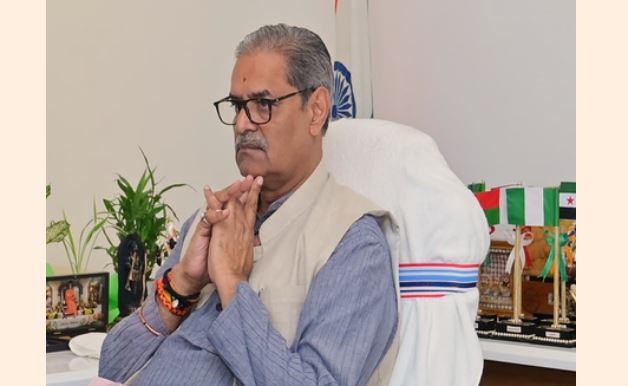
Bhubaneswar: Odisha is the only state which had prepared a standard operating procedure (SOP) to manufacture women-friendly farm machinery, Deputy Chief Minister Kanak Vardhan Singh Deo said in Bhubaneswar Friday.
He was speaking at the inception workshop on Institutionalising the Gender Responsive Cell: Framework and Roadmap.
The Department of Agriculture and Farmers’ Empowerment of Odisha, in collaboration with the International Food Policy Research Institute (IFPRI) and with support from the Gates Foundation, organised the workshop here.
It is worth noting that the Odisha government had inaugurated the Gender Responsive Cell in November at Krushi Bhavan, underscoring the state’s commitment to advancing women-led development and inclusive agricultural systems.
Addressing the gathering, Singh Deo said, “When we launched the cell last year, it signalled Odisha’s commitment to inclusive and evidence-led agricultural reform. We are proud to share that Odisha is the only state which has developed an SOP to manufacture women-friendly farm machinery.”
The workshop marks the next step of operationalising the commitment and ensuring that research insights translate into tangible improvements in schemes and services, he said.
Women and Child Development department secretary Mrinalini Darswal emphasised this need for interdepartmental convergence.
“Women’s empowerment cannot be addressed in silos. The gender responsive cell creates space for convergence across agriculture, women and child development, and data systems, which is essential for translating women-led development into measurable outcomes,” she said.
Agriculture & Farmers’ Empowerment Department Secretary Sachin Ramchandra Jadhav described the Gender Responsive Cell as a governance reform.
He said, “The GRC represents a shift toward accountable and evidence-driven agricultural governance.”
Highlighting the role of research and academia, Odisha University of Agriculture & Technology Vice Chancellor Pravat Kumar Roul said gender-responsive agricultural transformation must be grounded in rigorous evidence and continuous learning.
Institutions like the GRC can serve as vital bridges between research, policy, and practice, he said.
PTI