BHUBANESWAR: Pilgrims from the state will soon witness ‘Dasapalla Lankapodi Yatra’ and ‘Dasapalla Ram Leela’ at Mahaveer Kshetra, Daspalla, in Nayagarh district.
The ceremony which is observed every year is continuing since 1802 AC. Locals claim that the festival is the oldest and only one of its kind.

The 218-year-old open air theatre is famous all over the world. Some of the unique features of the festival make it distinctive.
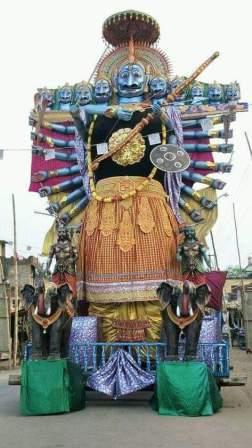
Unique representation of “Ram Leela” staged in open pendals, an open air dramatic final battle between Lord Ram and a 35 ft. high centuries-old movable Ravana statue, movable Puspaka Viman/ Divya Rath, which can be moved three dimensionally with century old technique are some of the exciting features of the festival.
However, the trademark of this festival is ‘Ravana Dahana’. A 25 ft. high temporary statue of Ravana made of bamboo and paper is blazed by a cracker named ‘Brahma-sara’.
During the course of the two-week-long festival, which begins from Shree Ram Navami to Shree Ram Rajabhisheka, Daspalla turns into open air theatre for staging various episodes of ‘Ram Leela’ such as ‘Ganda Badh (Hunting Rhinoceros), Guhaka Sabara bheta (Meeting of Guhaka sabara), Sita Harana (Kidnapping Sita), Ravana Chatra chhedan, Ravana badha and Sita Agni parikshya among others.
The main attraction of the Yatra is Ravana dahana and Lanka dahan (which is organised only Tuesday). It is scheduled for April 23 this year. The specially designed illuminated cracker Brahma-Shara is returned to Lord Ram after the ceremony.
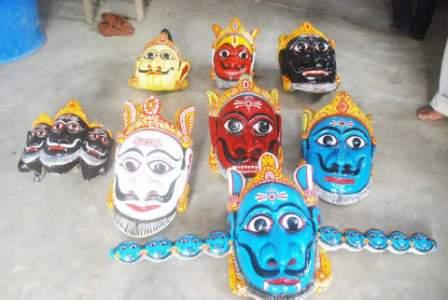
The uniqueness of ‘ Dasapalla Rama-Leela’ staged in open pendals, is the wearing of centuries-old wooden masks (similar to the ones used in Chhau Nrutya) by mythological characters like Hanuman, Angada, Ravana, Indrajita, Srupanakha and jambabanta among others.
Live recitation of song/dialogue/dramatic folk verses of scripts written by ‘Vikrama Naredra’ (Odia poet) in a typical lyrical form aided by two musical instruments Mrudanga and Ginis (cymbal) is another major attraction of the festival.
Two mashalas (torches) are lighted during the Leela performance. One is dedicated to Lord Mahaveer and another for Leela manuscripts. Every ritualistic practise in the observance has descended down since several generations.
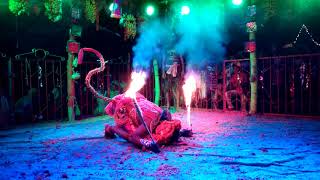
In addition, the mythological characters perform a classical lyric-based dance form known locally as “Adheipaada” (two and half steps style) throughout the leela irrespective of sequences and characters with little variance.
All actors and committee members maintain a dedicated life with sanctity throughout festival with ‘bear brata’ (sacred thread). This is because it isn’t simply a celebration. It’s a temple-based tradition which is organised since the last 218 years.
Over lakhs of pilgrims congregate to actively participate during in the procession. They are treated to bright fireworks throughout the dramatic battle between Lord Ram and Ravana which takes place in an area of 1.5 sq kms.
Though the Lankapodi Yatra is a congregation of Hindu pilgrims, people irrespective of caste, religion and gender participate in the epic festival.
The celebration also provides a platform to various traditional folk dances like Bharata Leela (Duari), Dasakathia, Pala, Ghudki, Changu, Bagha Nacha, Ghoda Nach and Paika Nacha among others.
Chaitali Shome, OP