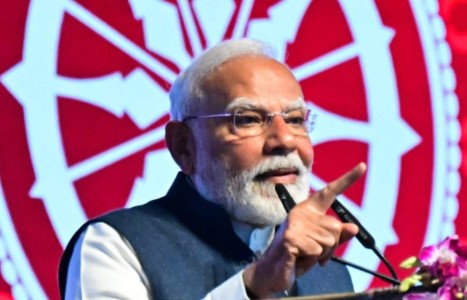
When Prime Minister Narendra Modi urged the people in the country on 10 May to curb fuel use, reduce overseas travel, and pause gold purchases, he is probably the only leader, among so many other Heads of State, who had such a large list of Don’ts for the citizens. It was simply to underscore the need for austerity measures in view of the severe impact of the US-Israel-Iran war on the economy.
As global fuel prices keep surging, the PM further appealed to Indians to use public transport, work from home and carpool to conserve fuel and warned that the country needs to be prepared for the neo-normal reality that had become the norm during the CoVID-19 pandemic. In the days following the start of the war, a number of countries introduced measures to cushion the consumers against the impact on the economy.
Also Read

For example, China ordered its oil refineries to stop exporting fuel for the time being and some Chinese airlines cut flights as jet fuel prices went up. Some Australian states have made public transport free or slashed fares by half to encourage people not to drive. The Philippines declared a national emergency in March and its government offered subsidies to transport operators, reducing ferry services and implemented a four-day work week for civil servants. Sri Lanka too introduced fuel rationing and temporarily turned to a four-day-week and shut down schools, colleges and other government institutions on Wednesdays.
They all took early remedial steps and the chief executives of those countries did not require any dramatic announcements. India’s situation has been different because impending elections to several state assemblies ensured the cushion for the citizens. That softness may not be required any longer, so the nation is being prepared for the jolt. Viewed in this backdrop, PM Modi’s response, though very positive, appears to be too drastic. When looking at each point, the instruction to Work From Home (WFH) concept is virtually impossible for the poor toiling masses of this country to obey.
Construction, mining, transport and even domestic help need to earn their daily bread daily. Disappearance is not an option for them. Even journalists and engineers will find it impossible to work from home. The bulk of India’s poor have to work daily as they have barely any savings to fall back on. Let us forget the WFH idea as being impractical for the largest part of the population.
The majority of poor, lower and middle class are not in a position to buy gold at the current rate. Their savings are negligible. India’s economy has so very drastically shrunk in the last decade that these huge chunks of society have fallen down a few notched in the economic ladder. Touching that yellow metal has become a dream for most of us. To add to this is the case of the approximately one crore employed in the gold and silver ornament manufacturing enterprises.
If calculated, each worker would have nothing less than four dependents each. That adds up to about five crore daily toiling citizens spread across the nation who would surely miss their daily bread if others, obeying the instructions, stopped buying ornaments for a year. The very idea of suggesting that using metros or public transport to work and other activities must be done shows how far removed from reality the whole concept can go. Undoubtedly, the fuel crisis is genuine and needs immediate action.
However, even towns like Bhubaneswar, Berhampur, Sambalpur, Rourkela, Angul Cuttack and Balasore have not tasted development in public transport. There are no metro rail in most towns and middle level cities of India. Only Metro cities can claim to posses, at best, shadows of public transport. A ride in Delhi metro or Bombay suburban trains during office hours is a great experience for anyone who has done it regularly. The Gov’t has never bothered to develop this sector in the last decade. Rural India is way behind in such matters. Asking people to save fuel in this fashion sounds impractical. Cutting down the use of cooking oil in Indian kitchens seems a slightly possible idea.
While Eastern and Southern Indian cuisine use less oil, North and Western Indian menus are soaked deep in oil. How eagerly this intrusion into the privacy of food and kitchen will be welcomed by most Indians is to be watched. Asking farmers to reduce use of chemicals and fertilizers and opt for natural farming sounds healthy and fancy. The Prime Minister, in one of his early speeches in Parliament, had praised Sikkim for going in for complete organic farming in that state.
However, except for speaking, the Gov’t has done nothing over the past decade and more to encourage alternate farming. Farmers are the poorest in this country and still, because of India’s food sufficiency, we are all better off than many other nations but our farm sector has been completely ignored after the fall of the three Farm Bills.
A sudden demand to bring down fertilizer consumption may not show any results. Before the current Gov’t came to power in 2014, the nation was aware and many of us welcomed the activities of Swadeshi Jagran Manch, an organization that used to support the BJP. After the party came to power, that organization has been pushed to oblivion and all the suggestions cold shouldered. Asking people to go Swadesh in this Amazon door delivery age sounds highly impractical and unimplementable. Instructing citizens to stop foreign travel may negatively impact small and medium businesses and entrepreneurs along with students whose future will become bleak.
The talk doing the rounds on social media that police will be used to monitor and collect data on all those who enter gold and ornaments shops, petrol stations, airports and such places may not help the overall climate prevailing in the country. These seven points are, no doubt, very welcome and should be implemented but all of them needed long term planning which has not been done.
A knee jerk announcement like the one made on 10 May 2026 will only result in discreet disobedience, an unwanted fallout for some positive suggestions.