
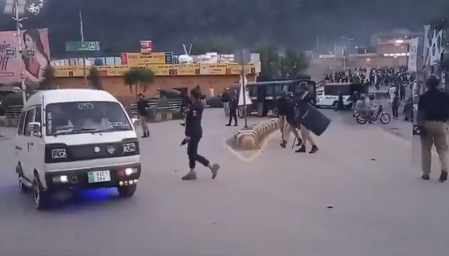
New Delhi: Pakistan-occupied-Kashmir (PoK) is burning, and neither the protesters nor the establishment is showing any signs of backing down. The directive from the top man in Pakistan, Field Marshal Asim Munir, is clear, and that is to put down the protests using brute force. However, Pakistan’s crackdown has exposed the selective silence of global rights groups.
In recent days, horrific stories have emerged from PoK. 1,500 people have been arrested using anti-terror laws. Women and children have been fired upon by the Pakistani security forces, while the bodies of the men killed by the security forces are not being returned to their family members.
Officials say that the atrocities continue with each passing day.
The international community and global human rights advocacy groups, which are usually very vocal about issues relating to Jammu and Kashmir, are surprisingly quiet when it comes to PoK.
The official said what is taking place in PoK is brutal abuse of human rights. The same groups had spoken out loudly when it came to the abrogation of Article 370 and the crackdown on terrorists in Jammu and Kashmir.
Despite the Joint Awami Action Committee (JAAC) pleading with the international community and human rights advocacy groups, there is pin-drop silence, the official added.
Another official said that the silence clearly signals how a network of digital platforms, western lobbies and regional figures is selectively silent and prioritises Islamabad’s geopolitical narrative over the human rights of the PoK people.
The crisis in PoK erupted when the Pakistani establishment failed to keep its promise of bringing reform to the region.
The protests are now being led by the JAAC, which comprises a coalition of traders, lawyers and civil society members.
Also Read : Pakistan intensifies disinformation campaign amid PoK protests
They have been seeking economic relief, political sovereignty and curtailment of elite privileges and luxury administrative expenditures for government officials.
On one hand, the establishment assured that there would be talks with the JAAC and June 5, the state officially banned the group under anti-terrorism laws.
Officials say that this move turned the civilian community organisers into enemies of the state overnight.
Further, Pakistan banned Internet and mobile services in the region and local channels, too, were suspended.
The state police, which is in charge of law and order, was replaced with heavy contingents of the Punjab Rangers to crush the protests.
June 7 and 8, the Rangers opened fire on demonstrators in Rawalot, during which 30 civilians were killed.
Disinfo Lab, a group of researchers who investigate Info-warfare and Psy-war, in a series of posts on X, questioned the silence of the global ecosystem, think-tanks and NGOs, which claim to stand up for Kashmiri self-determination.
These groups are quick to post updates regularly about civil rights in Jammu and Kashmir, but not in PoK. There was a stoic silence from these groups to the events that took place June 7 and 8, Disinfo Lab also said.
The feed of the international advocacy handles such as @standwithkashmir and @wka_kashmir only posted anti-India feed through June. Despite the deaths in PoK being documented, these groups offered no solidarity and no human rights reporting on the crisis.
Organisations such as the Kashmir Institute of International Relations, which has offices in PoK, were clearly compromised.
Moreover, organisations in the West, which are linked to the Ghulam Nabi Fai network, the Kashmiri American Council, Pakistan House and Centre for Strategic and Contemporary Research also had nothing to say about the events in June.
These entities, according to Disinfo Lab, are built on a specific narrative framework that is designed to challenge Indian sovereignty while portraying Pakistan as the champion of human rights in Jammu and Kashmir.
Officials say speaking about the PoK issue would undermine the premise of their lobbying efforts and endanger their support structures.
Another development that one got to witness was when prominent Kashmiri-origin political figures, instead of condemning the violence, stepped up to delegitimise the protesters in PoK. None of them appealed to Asim Munir to put an end to the hostilities and gross violation of human rights in PoK.
Mushaal Hussein Malik, a prominent political figure and former advisor to the Pakistani government, finally broke her silence.
However, this was not to condemn the civilian killings in PoK’s Rawalot, but to call on the JAAC protesters to disband immediately. She called the protests a political conspiracy which is aimed at destabilising the region.
An official said that these groups have only focused on Jammu and Kashmir, and even in the past, never uttered a word about what is going on in PoK. These groups have always spoken about the lives of people in Jammu and Kashmir so that they can use it as leverage against New Delhi.
All these advocacy groups are well aware that post the abrogation of Article 370, the lives of the Kashmiris have only improved. The eradication of separatism and the fight against terror has only seen tourism booming in Jammu and Kashmir, and this is much to the disliking of these international advocacy groups, officials also said.