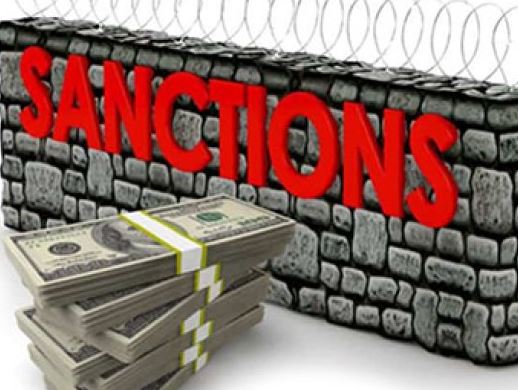
Ottawa: The wave of sanctions that has followed Russia’s invasion of Ukraine has been described with adjectives such as “massive” and “severe.”
Another word has also often been used to describe sanctions on Russia: “targeted.” Ursula von der Leyen, the head of the European Commission, has even used both words side by side, describing “a package of massive, targeted sanctions.”
So who’s being targeted? Canadian Prime Minister Justin Trudeau has stated that Canada’s sanctions would “impose severe costs on complicit Russian elites.”
Similarly, Chrystia Freeland, Canada’s deputy prime minister, has spoken of “targeting the people who have been Putin’s fellow travellers.”
British Foreign Secretary Liz Truss has argued that sanctions would “squeeze Putin’s regime and all those close to him.”
This emphasis on targeting the “elite” is in line with a longstanding principle of sanctions policy.
For example, as stated in the European Commission’s explainer on the EU’s sanctions policy, sanctions should be “aimed at those responsible for the policies or actions the EU wants to influence.”
Why target the elite? The idea is that to achieve the stated goal of sanctions — “to bring about a change of policy or activity,” in the words of the European Commission — they must be designed to affect the decisions of people with political power.
If sanctions can change the cost-benefit calculations of the powerful, then they might lead to policy change.
Targeting the elite in Iran
In our upcoming research paper, “On Target? Sanctions and the Economic Interests of Elite Policymakers in Iran,” we’ve investigated how this might work in practice.
Our study focuses on another recent “massive, targeted” sanctions regime: the multilateral sanctions on Iran that preceded the 2015 nuclear deal.
These sanctions were prompted by Iran’s nuclear program, with the aim of preventing Iranians from producing nuclear weapons.
Like the new Russian sanctions, they included severe limitations on Iran’s international financial access, restrictions covering entire industries (such as oil and automotives) and many narrower measures such as asset freezes focused on specific firms or people.
Our study examines the possible role that “elite targeting” played in the diplomatic negotiations leading up to the nuclear deal.
During the negotiations, the sanctions package essentially acted as a “carrot” — if Iran agreed to limits on its nuclear program, it would get relief from sanctions in return.
But was this incentive directly relevant to elite policy-makers in Iran? What did they gain from progress towards a deal securing sanctions relief?
Our research focuses on those with significant political influence over the nuclear program: the Supreme Leader Ali Khamenei and the Islamic Revolutionary Guard Corps (IRGC).
Importantly, both the supreme leader (through an organization known as Setad) and the IRGC are known to control substantial economic holdings.
While the value of most of these assets is opaque, the key to our study is that we are aware of some assets of both organizations that are publicly traded on the Tehran Stock Exchange. This means that we can examine whether diplomatic progress resulted in a rise in the value of these holdings.
Market reacted
Our study finds that when negotiators moved closer to a deal, the market reaction boosted stock returns for firms owned by Setad and the IRGC. Other publicly traded firms also benefited, but to a lesser extent.
While companies in sanctioned industries were boosted in general by progress in negotiations, Setad and IRGC holdings in those industries saw significantly larger returns.
Perhaps the biggest breakthrough in negotiations with Iran was the 2013 interim Geneva agreement. This deal raised expectations about eventual sanctions relief and immediately boosted the Iranian stock market.
Our estimates suggest that the Geneva deal led to a rise in the value of publicly traded Setad and IRGC assets by hundreds of millions of dollars.
This may actually be a highly conservative estimate of their gains, because most of the economic interests of these organizations are privately held and so not included in our study.
Lessons for Russian sanctions
As in Iran, reliable valuations of many of the assets of Russian elites may be difficult to attain. Nonetheless, a similar approach could be used to gather some information on the effectiveness of targeting.
How? It might involve monitoring fluctuations in the known stock market wealth of key members of the elite both when sanctions are tightened or when a diplomatic resolution to the conflict seems possible.
In the case of Russia’s elites, access to amenities is another potential indicator: to what extent are the lifestyles of the elite affected by the sanctions?
Such monitoring could be a long-term proposition. The gap between the initial imposition of sanctions on Iran and a diplomatic breakthrough was measured in years.
The first UN Security Council resolution on Iranian sanctions was passed in 2006. But serious progress in negotiations only started after the sanctions were tightened between 2010 and 2012, and the final nuclear deal wasn’t reached until 2015.
Our findings suggest that the multilateral sanctions on Iran may have created “targeted” incentives for elite policy-makers to negotiate a deal. But we should also consider the “massive” nature of the sanctions on Iran.
Beyond the firms listed on the Tehran Stock Exchange, there is ample evidence that the Iranian economy as a whole suffered greatly from sanctions.
If they’re successful, sanctions on Russia might eventually change the course of events through their impact on the circumstances of elite influencers. But they also have the potential to cripple the rest of the Russian economy.
By Jason Garred, Economics Dept, L’Université d’Ottawa/University of Ottawa; Mirko Draca, University of Warwick and Nele Warrinnier, Senior Research Fellow, KU Leuven
The Conversation