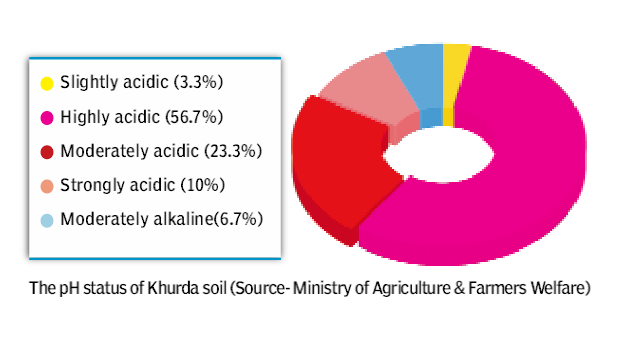
Bhubaneswar: In what seems to be an alarming sign for Khurda district’s food production, a large percentage of soil samples have been reported as highly acidic. Experts have suggested potential nutrient depletion in the district’s produce if necessary steps are not taken. According to the data provided by Department Of Agriculture Cooperation and Farmer’s Welfare, Khurda was only behind Mayurbhanj with about 56.7% of minimum 5,000 samples in the district reported as highly acidic.
“The optimum pH value of a soil should be between 6.5 and 7.5. Soil samples can have varied pH values depending on the seasons and locations but the range lies at less than 4.5 which is highly acidic; 4.5 to 5.5 is moderately acidic and 5.5 to 6.5 is lightly acidic,” explained Sharda Prasanna Kar, soil chemist at the state quality control laboratory. While the state had an overall 46% of pH rating in moderately acidic range, Mayurbhanj reported largest share of soil with 72% of it in highly acidic category. This was followed by Puri with 65.6%, Kendrapara with 62%; Nabarangpur 57.4% and Khurda with 56.7%. Figures are from last duration 2015-16 and 2016-17 with minimum 1,000 samples. In layman terms, it means highly acidic soil will result in reduced production. “Essential nutrients such as phosphorous, calcium, magnesium and molybdenum will become unavailable if the soil has low pH. This will only result in an increased dependance on fertilizers to sustain any form of productive agriculture,” stated Sharda.
While the rising levels of acidity remain a concern for the entire state, it’s an alarming sign for Khurda where agriculture plays a vital role in economic development of the district. Around 500 samples from Tangi were reported to be highly acidic followed the samples from by Jankia and Banapur. The reports also suggested that 90% of soil of the state has been gradually decreasing on pH meter and the decline is expected to grow even further. While the demand for food in state is increasing each year, degrading soil chemistry is suggested to decrease the production in the state by 13% in the next decade.
Citing excessive use of fertilizers to meet the growing demand of the food production, Sharda said that every pinch of the chemical leaves some acid in the soil which is termed as residual acidity. This process, if done repeatedly, depletes the soil of its microorganisms.
“Condition of the soil cannot resort to what it was like a decade ago. But if farmers are made aware to certain measures such as adding two quintal of lime to every acre for maintaining soil acidity and use homemade compost instead of fertilizers the situation can be brought under control,” Sharda concluded.
Soil acidity plagues food production