
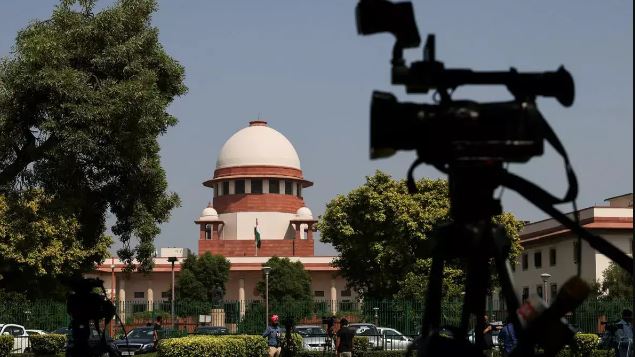
New Delhi: In a scathing observation, the Supreme Court Tuesday said that most states tend not to follow the judgment in the 2006 Prakash Singh case in order to have directors general of police (DGPs) of their choosing. The observation was made by a bench of CJI Surya Kant and Justices Joymalya Bagchi and V Mohana while reserving its order on pleas challenging the process followed by the Odisha government in selecting candidates for appointment of the state’s DGP.
On September 24, the bench asked the Odisha government if it had put a senior IPS officer, whose name was excluded from a list of officers being considered for the DGP’s post, in the category of accused after the CBI stated that he might need to be questioned in a recruitment exam scam case. While reserving the verdict, the CJI said that the bench would see whether the appointment of the DGP in Odisha and Jharkhand was made according to the directions issued by the SC in the 2006 judgement. “The state would like to derail the appointment process and do not want to follow the Prakash Singh (judgement)… they want to have the DGP of their choice,” the CJI said.
The SC also came down heav ily on the Union Public Service Commission (UPSC), which was tasked by it to shortlist three names of senior Indian Police Service (IPS) officers amongst the list provided by states for appointment as the DGP, for its “casual approach”. “The casual approach is reflected everywhere, and you are in a position of trust conferred by this court. First of all, it is very difficult to reconcile the composition of the (UPSC) committee itself. This is all just an eyewash,” the CJI said. “The appointment of DGPs is governed by judicial orders of this court. Every state has to satisfy us that the appointment is in accordance with the orders of this court,” the CJI added.
The bench heard arguments on a PIL and other pleas alleging that the Odisha government was seeking to include a relatively junior officer in the zone of consideration for the DGP’s post contrary to the directions issued by the SC in the 2006 judgement. The exclusion of senior IPS officer Sushant Kumar Nath from the list after the CBI informed the state that he might be required to be examined in connection with an investigation into the Odisha Police recruitment examination was also deliberated upon in the hearing. The Odisha government had initially forwarded a panel of 11 senior IPS officers to the UPSC in May for consideration for the DGP’s post. Nath’s name was subsequently withdrawn after the CBI’s communication.
Solicitor General Tushar Mehta, appearing for Odisha, told the bench that the CBI had informed the state August 4 that Nath, who was chairman of the Odisha Police Recruitment Board when the examination was conducted, “may be required to be examined” after necessary permission was obtained and officials concerned were examined. The state subsequently withheld Nath’s integrity certificate and forwarded a revised proposal containing integrity certificates for 10 officers, the SC was told. Mehta said the state had reviewed the integrity certificates of all eligible officers as a measure of “abundant caution and due diligence”. Justice Bagchi, however, questioned whether the material supplied by CBI showed that Nath had actually been named as an accused.
Orissa POST – Odisha’s No.1 English Daily