
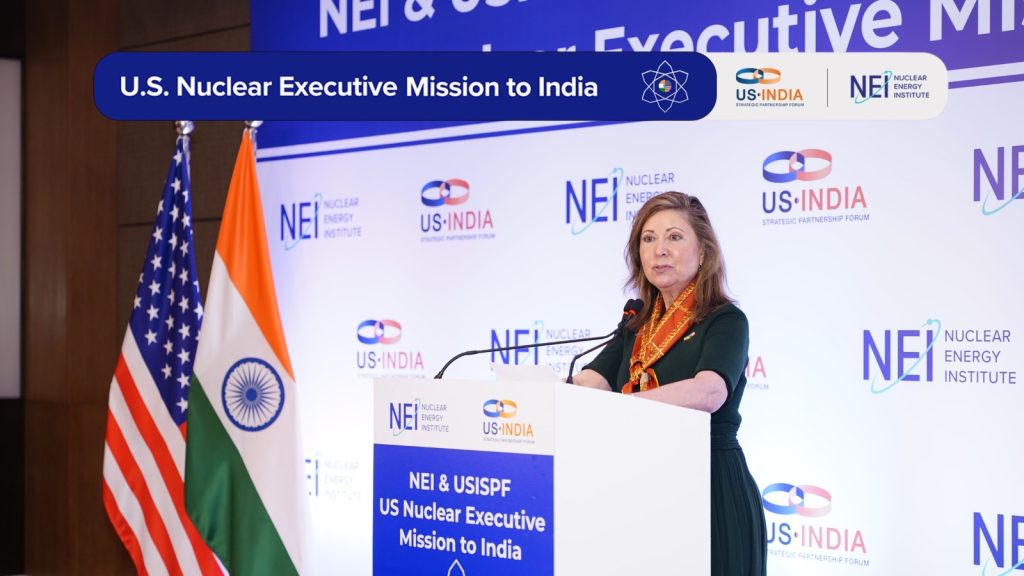
Washington: India with its strong supply chains and engineering talent is the perfect partner for the US in the civil nuclear sector poised for exponential growth, Maria Korsnick, President and Chief Executive Officer of the Nuclear Energy Institute (NEI) said .
Korsnick was in India a fortnight ago leading a 20-member delegation from the US nuclear industry to explore opportunities as New Delhi opened the tightly-controlled atomic power sector for private players by easing the draconian liability law.
India has a very strong supply chain and very strong engineering talent. You’re not new to nuclear. You understand it and have worked very well with it in a very established sector. And that, to me, just makes the perfect partner to go with the innovation in the US, Korsnick told media in an interview at the NEI office here.
She said the US nurtured innovation through its national labs over many, many years which was now being brought to the marketplace.
It just feels like a perfect marriage. I think because we’re approaching that both with really strong skill sets, that’s really what sets the backbone for building this trust, Korsnick said.
She said India and the US have rolled out aggressive plans for the growth of the nuclear sector which presents an opportunity to work together.
India plans to increase its nuclear power capacity from the present 8.78 GW to 100 GW by 2047. In a similar timeframe, the US plans to increase its nuclear power capacity from 100 GW to 400 GW.
That’s an opportunity why we’re working together, because we’re both going through a very significant build-out, Korsnick said, adding that small modular reactors (SMRs) are an area of future growth.
The US is investing big in fast-tracking deployment of SMRs with at least three such pilot projects expected to go critical by July 4, when the US celebrates the 250th anniversary of its independence.
Korsnick said the Sustainable Harnessing and Advancement of Nuclear Energy for Transforming India (SHANTI) Act will help regain the lost momentum in the India-US civil nuclear sector over the past two decades due to unresolved liability issues.
It was 20 years ago when we took a trade mission to India after a nuclear pact had been signed. There was a lot of momentum and maybe interest that there could be something. And now, look, 20 years have gone by, Korsnick said.
India and the US signed the civil nuclear agreement in July 2005. Over the next three years the US amended its laws to allow New Delhi to engage in nuclear commerce — both fuel and technology — with Washington.
However, the passage of the Civil Liability for Nuclear Damage Act in 2010 prescribed stringent penalties on suppliers of nuclear equipment, which kept global private players away from the Indian civil nuclear market.
I think what’s wonderful is that the Shanti Act is really a new foundation which opens a door for cooperation between our two countries, Korsnick said, adding that it provided a perfect opportunity to build trust.
She called for closer coordination between governments and the industry in both countries to ensure the new law helps in the growth of the civil nuclear sector.
From a nuclear liability perspective, which was really one of the sticking points, I think the Shanti Act, as we understand it, addresses that, Korsnick said. The focus should now be on implementation of the law, she added.
What is important right now is that the nuclear sector, both commercially and with our governments, continues to work together to ensure that we get the value that we think that we see in the Shanti Act. We just need to learn to work together to make sure we’re not creating other challenges and issues, Korsnick said.
She said both India and the US have to work on processes for sharing nuclear information and make it more efficient for the partnership to flourish.