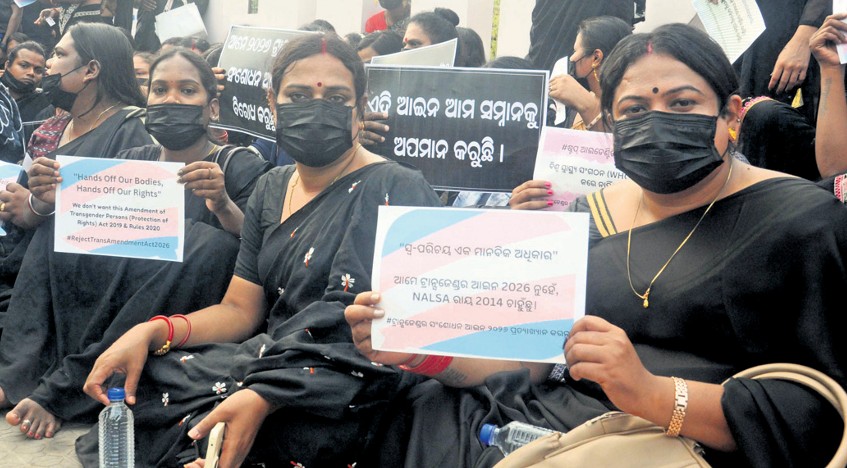
Bhubaneswar: Members of Odisha’s trans gender and gender-diverse community stage a protest here at Master Canteen Square Tuesday, opposing the pro posed Transgender Persons (Protection of Rights) Amend ment Act, 2026 (Bill No. 79). The demonstrators raised concerns that the amendment could un dermine the rights, dignity, and legal recognition of trans gender individuals across the state and beyond.
Activists and community representatives described the bill as a step backwards, warning that several of its provisions threaten hard-won protections and freedoms. A central concern raised during the protest was the perceived erosion of the right to self-identify one’s gender— an essential principle previously recognised as a fundamental right.


Participants also expressed alarm over potential restrictions on gender identities, noting that the proposed changes could exclude or narrowly define identities such as trans men, trans women, and gender queer persons. Many speakers emphasised that such limitations would fail to reflect the diversity and lived realities of gender-diverse communities. Another major point of contention is the introduction of mandatory medical verification for legal gender recognition.
Protesters argued that requiring certification from medical boards infringes on personal autonomy, privacy, and dignity. Further criticism was directed at provisions that could effectively compel individuals to undergo surgical procedures to obtain legal recognition—an approach widely condemned by rights advocates as coercive and inhumane.
Beyond identity-related concerns, the community also highlighted the bill’s lack of robust legal safeguards against discrimination, violence, and abuse. Activists warned that without stronger protections, the amendment could leave transgender individuals even more vulnerable to marginalisation and systemic exclusion.
During the gathering, demonstrators collectively called on the government to reconsider the proposed changes. Their demands include the preservation of self-identifying rights, the removal of mandatory medical and surgical requirements, and the introduction of stronger legal protections.
They also urged authorities to ensure equitable access to education, healthcare, and employment opportunities for transgender persons.