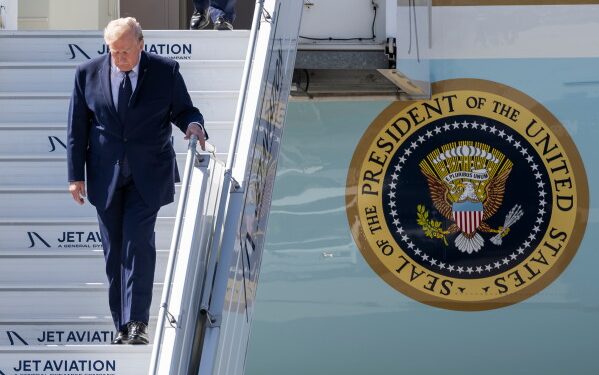
Evian-les-Bains: President Donald Trump arrived in the French Alps Monday to meet with fellow world leaders at the Group of Seven summit after announcing an agreement he says will bring an end to the US war with Iran.
Trump and Iranian officials had been saying for days they were making progress toward reaching a deal, but even Sunday, things appeared to be on shaky ground after a new round of strikes between Israel and Iran-backed Hezbollah militants in Lebanon.

With the agreement, the Republican US president arrived in Evian-les-Bains Monday with the wind at his back for talks with G7 leaders, including some who’ve been sharply critical of his managing of the 15-week-old conflict, which has led to a surge in global energy prices.
Polls show American voters largely disapprove of the conflict, which has made some Republicans nervous about the political impacts it could have November’s midterm election.
“Ships of the World, start your engines,” Trump said in a social media post celebrating the deal that he said would lead to the US ending its blockade of the Strait of Hormuz, through which about 20 per cent of the world’s crude had flowed before the conflict. “Let the oil flow!”
Iranian Deputy Foreign Minister Kazem Gharibabadi, however, said the Iranian closure of the strait would continue until the agreement is signed.
Neither the White House nor Iran published the final agreement or revealed many details. Pakistani Prime Minister Shehbaz Sharif, whose country served as a mediator in the negotiations, said there would be “pre-implementation discussions” this week to lay the ground for 60 days of technical talks on Iran’s nuclear program.
Vice President JD Vance told CNBC Monday that the White House hopes to release the text of the agreement in the coming days.
Deal could change G7 dynamic
Sealing an agreement before jetting off to the summit could change the dynamic of the gathering for Trump. He’s had friction with French President Emmanuel Macron, British Prime Minister Keir Starmer, German Chancellor Friedrich Merz and Italian Prime Minister Giorgia Meloni over failing to consult them before the decision to go to war.
Meanwhile, Trump has pushed back on the four European leaders – members of the NATO military alliance – for their lack of support for the US in the conflict.
Trump is expected to discuss with leaders the demining of the Strait of Hormuz, the White House says. Britain and France have expressed interest in assisting with the demining once the conflict is paused. Fear of potential mines is among the reasons tanker traffic has come to a halt during the war, and quickly clearing them will be crucial to regaining the confidence of commercial vessels.
Macron Monday said France was ready to move “very quickly” to deploy assets, including mine-clearing vessels, to the region to help.
He added that a French aircraft carrier and an accompanying strike group are already in the region and would be ready to assist within days of the US and Iran signing the agreement.
Macron, the summit’s host, invited the leaders of three nations that aren’t part of the G7 – Egypt, Qatar and the United Arab Emirates – to take part in a session on the Middle East Tuesday, when Iran is expected to be a central focus.
The leaders of the UK, France, Germany, Italy and Canada issued a joint statement welcoming the agreement as a “moment of opportunity to restore regional stability and stabilize the global economy.”
In a separate development, Trump, ahead of departing for the summit, told the New York Post he’s warned Macron the US will “have no choice” but to slap 100 per cent tariffs on French wines unless? Paris eliminates its digital tax on American tech companies, renewing a long-running threat from him that dates to his first administration.
Wines and spirits exported to the US from the European Union currently face a 15 per cent tariff.
In an interview with broadcaster TF1, Macron said Monday that it’s not “for the United States to decide what European or French law should be.”
Trump is scheduled to meet with Macron later Monday. Following their meeting, Macron and Trump will join the other leaders for a working dinner.
Trump faces questions about financial incentives for Tehran
Trump had fiercely criticised President Barack Obama for the 2015 nuclear agreement, which Trump argued failed to stop Tehran from advancing toward a weapon and funneled billions of dollars into the Islamic Republic’s coffers.
In 2018, Trump exited the deal, known as the Joint Comprehensive Plan of Action. Britain, China, France, Germany, Russia and the European Union were also signatories to the pact.
Trump in an interview Sunday with The New York Times pushed back on comparisons to the Obama-era nuclear deal. “We negotiated from strength,” Trump said. “He was basically paying them off.”
But Trump hasn’t detailed how his agreement will address some key issues about Iran’s nuclear program, including who will be in charge of verifying that Iran is complying with the agreement and who will destroy or remove 972 pounds (441 kilograms) of highly enriched uranium believed to be buried under nuclear sites that were badly damaged by US strikes last summer.
The deal is also expected to include some sanctions relief and economic incentives for Tehran as it meets certain benchmarks aimed at assuaging White House concerns, senior administration officials said ahead of the two sides reaching an agreement.
Some Democrats and hawkish critics say Trump has failed to explain how the financial relief in his agreement will differ from what Obama did in the 2015 nuclear deal.
“For all his critique of JCPOA, we had international observers, we actually had an alliance there that included the Europeans, and Russia and China were all signatories,” Sen. Mark Warner, the top Democrat on the Senate Intelligence Committee, told CBS’ “Face the Nation Sunday. “Now it is America going alone or going with Israel only, and that does not make us safer.”
Republican Sen Lindsey Graham, a close ally of Trump and an Iran hawk, expressed skepticism, saying that Congress will need to review and vote on any nuclear deal with Iran, and said he expects Vance – “the architect of the deal” – to present it.
“I am somewhat concerned that Iran’s view of the agreement seems different than what the American negotiating team is claiming,” Graham said on social media.
Orissa POST – Odisha’s No.1 English Daily