
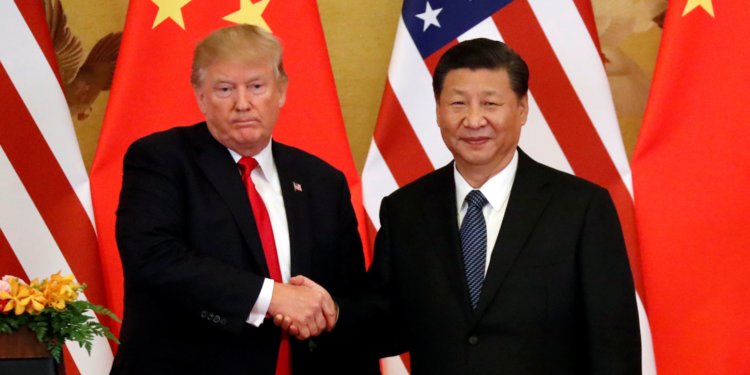
The recent meeting between US President Donald Trump and Chinese President Xi Jinping turned out to be a rather tame affair without any breakthrough in the Middle East crisis or the US-China trade war. The whole exercise was seemingly intended to be a grand spectacle that could benefit both the leaders.
Trump is going to face tough mid-term polls in November, while Xi is troubled by the slowing of the Chinese economy. Their meeting offered opportunity for both to pretend everything is under control. This explains why Trump went out of the way to personally greet Xi at the airport in a very rare gesture, according a red carpet welcome at the commencement of the three day state visit.
More than 100 people, mostly from the US government and businesses, attended a state dinner for Xi at Washington DC. However, the current diplomatic engagement between the USA and China does not result in tangible outcomes or in addressing in some way the strategic challenges. Significantly, the two sides did not issue a joint statement which is the norm.
But instead, they issued separate statements following the summit. They agreed on only a handful of points. It means they will continue with their respective positions where there is hardly any scope for finding common meeting grounds. The US and China agreed to hold an AI dialogue in the next two months and establish a communication channel for AI incidents.
While the US used the term “Super Intelligence,” China still referred to the technology as AI in its readout underlining differences in their perceptions. Trump and Xi also indicated some alignment on limiting Iran’s nuclear weapon capabilities and agreed “no country or institution can be allowed to impose tolls on international waterways.”
The two countries said they would establish a working group to discuss agricultural trade, with China’s Commerce Ministry specifying sector talks would start before the end of 2026. Despite the red-carpet treatment and effusiveness of both Trump and Xi, both sides showed wariness on crucial issues. Deliverables on trade, rare earths, refined oil, investment and AI are all limited and tentative. Although Taiwan was discussed, both decided not to give it prominence in their official readouts which suggests there was no progress.
The limited outcome of the summit is striking given the importance of the US-China relationship, which Trump often refers to as the “G2,” to the global economy and the international order. The two sides have effectively opted for managed rivalry rather than a substantive reset in ties. The extension of the trade-war truce by another two months reflects their shared interest in containing immediate economic damage.
At the same time, China’s restrictions on rare-earth exports have exposed a vulnerability that has constrained Washington’s appetite for a wider economic offensive. It was also a summit held under the shadow of the two wars in Ukraine and Iran.
In both the conflicts, the US and China fi nd them selves on opposite sides. So, discovering a common ground was expecting too much from this summit. With neither side prepared to make any major concessions, the summit was unlikely to produce a breakthrough.
What emerged instead was an uneasy accommodation with both Washington and Beijing seeking to prevent competition from spiralling into open confrontation even as they continue efforts to reduce their economic dependence on each other.
And, for the rest of the world, it is not business as usual with two ongoing wars, supply chain disruptions and soaring oil prices, upending economies and a battered world order.