
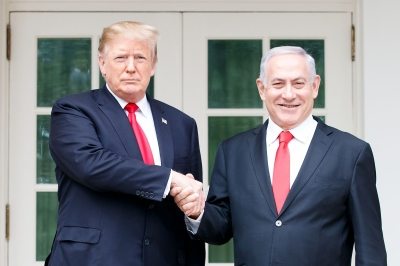
The renewed exchange of missiles between Israel and Iran through June 8-9 is ample evidence of instability continuing in the Middle East despite US President Donald Trump-induced ceasefire being in place. This could be because Trump and Israeli Prime Minister Benjamin Netanyahu are running at cross purposes at the moment. Both are under tremendous pressure due to compulsions of their respective domestic politics – midterm polls in the US in November and legislative elections in Israel in October. While Trump desperately needs an end to the war for the victory of his party, Netanyahu wants the continuation of the war to win the polls. This is the reason why peace has not returned to the Middle East even as Trump insists on achieving a breakthrough immediately. It seems like once the ball starts rolling, it is out of everyone’s hands.
Trump is increasingly asserting himself with reported snubs of Netanyahu for putting a spoke in his peace initiatives. His patience with his favourite ally seems to be wearing thin. Trump went out of his way June 8 to claim he is the dominant partner in the US-Israel relationship and it is he who “calls all the shots,” not Netanyahu. Less than a week earlier, the White House had leaked details of a foul-mouthed tirade from Trump, telling Netanyahu he was “crazy,” suggesting the latter did not know what he was doing, and informing him “everybody hates you now.” The tongue-lashing was believed to be intended to warn Netanyahu against attacking Beirut in his pursuit of Hezbollah, a red line for Iran in terms of what it considered a violation of the broader regional ceasefire. Trump was annoyed that Netanyahu had ordered firing a fresh salvo of missiles against targets in Iran despite managing to intercept the incoming projectiles; and his advice to Israel not to retaliate. “Things should move quickly,” Trump promised on his Truth Social platform, even though his repeated assurances over the past two months without real, tangible results, failed to have the desired impact on global oil prices. He is now seemingly worried that, despite Republican gerrymandering and voter suppression, Democrats’ hope of capturing at least one chamber of Congress in November elections may undermine his authority.
On the other hand, the electoral compulsions of Netanyahu push him in the opposite direction. As things stand, for all the bombing of the past three years, he cannot claim to have fulfilled any of his pledges to neutralize Israel’s major adversaries: Iran, Hezbollah and Hamas. This is why he wants further onslaught in the hope of a breakthrough, hoping for regime collapse in Tehran. To secure support from the Israeli Far-Right, Netanyahu has to show himself ready to defy Trump from time to time in pursuing that multi-front campaign. But no leader of Israel can afford to antagonize Washington.
Hence, a fine balancing act is needed. Netanyahu’s biggest achievement of his career is persuading Trump to join the attack on Iran, but Trump is now dragging cold feet fearing major upset in the November midterm. Already, the US-Iranian peace deal is being negotiated without Israeli participation and in its current reported form, would leave the regime in power with a restricted but continuing nuclear programme. By Tehran’s insistence, any agreement would also tie Israel’s hands in dealing with Hezbollah in Lebanon. Netanyahu’s political survival depends on failure of the peace talks. For all his repeated claims that peace is almost at hand, Trump has clearly found it hard to clinch a deal that is more in US’ interests than Iran’s.
For example, it would be hugely embarrassing for Trump if the deal allows the delivery of Iran’s bank assets frozen as part of sanctions. Trump and Netanyahu made a common cause in jointly declaring war against Iran as a remedy to their respective domestic problems. But, Iran’s spirited and continued offensive has proved Trump’s gamble has not paid off and that his confidence in Netanyahu was misplaced. Hence, he is trying for course correction by yelling at Netanyahu for his resistance against a peace deal. Last week he reportedly told Netanyahu in an expletives-filled exchange that he “would be in prison if it weren’t for me.” This two-man drama continues to cloud over the Middle East, bringing unending miseries to the rest of the world.