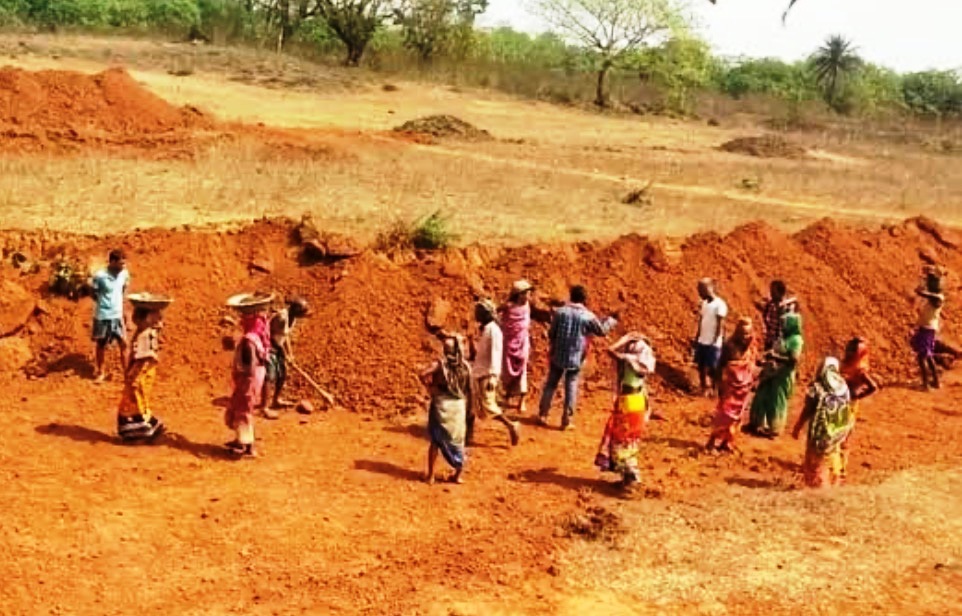
Jajpur: Despite its rich mineral reserves and industrial growth, Jajpur district is witnessing growing concern over local employment, with workers in Sukinda and Danagadi blocks preparing to migrate to other states in search of work, raising questions about the effectiveness of the Viksit Bharat – Guarantee for Rozgar and Ajeevika Mission (Gramin) (VB-G RAM G) employment scheme.
Labour contractors are reportedly offering advance payments to workers ahead of the end of the kharif harvest. Many are expected to leave their villages for destinations such as Chennai and Hyderabad after the paddy harvest.


The use of machinery in mining operations and the alleged preference for workers from outside Odisha in industries have further reduced employment opportunities for local people.
Delays in providing work and wages under the employment scheme have added to their difficulties.
Official figures for 2026-27 show that 233,820 people in the district have been issued job cards.
Of the 15,410 households that demanded work, 15,339 were offered employment, but only 11,797 households actually worked. In industrially developed Danagadi block, 14,712 households have job cards.
Of these, 1,023 households sought work, 1,020 were offered employment, and only 728 actually worked.
In mineral-rich Sukinda block, 1,133 households demanded work, 1,128 were offered employment and 879 received work. Despite eight months of the financial year having passed, no household in the district had completed 125 days of work, according to the figures cited in the report.
Allegations of irregularities in muster rolls and job cards, including the withdrawal of funds in the names of deceased people and those in employment, have also raised concerns about the scheme’s implementation and may be affecting workers’ confidence.
The consequences of distress migration can be severe, with some workers reportedly dying in accidents or returning with disabling injuries.
A worker from Deulakan panchayat in Danagadi has reportedly not returned home since migrating for work two years ago.
The prospect of distress migration from a mineral-rich, industrial district has intensified concerns over the availability of local jobs and the implementation of the rural employment scheme.