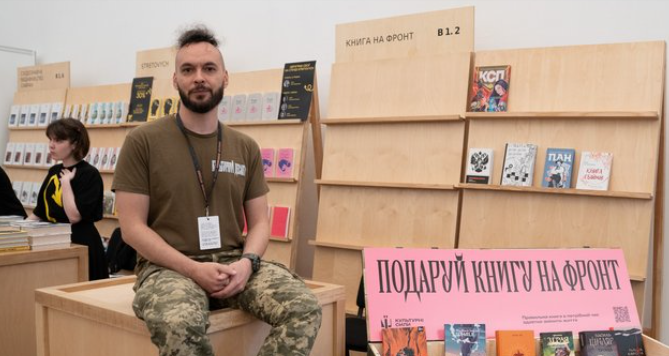
Kyiv saw a unique phenomenon recently when thousands of readers gathered at a literary festival defying air raids only to listen to their writers-turned soldiers and soldiers-turned-writers go beyond sharing their experiences in the theatres and talk about life beyond war. They have been facing brutalities of war for the past four years, but the seemingly unending cycle of war has failed to destroy their appetite for literature in the form of reading and writing. The festival virtually turned into a protest against Russia’s systematic attempts to destroy Ukrainian culture and with it their very identity. The authorities had to repeatedly interrupt the proceedings of announcing the winners of several prizes as sirens were blared for possible drone and missile attacks by Russia. But, there was unflagging enthusiasm for new books. Over 700 libraries were destroyed or badly battered within the first three years of the full-scale invasion.
Even when war wreaks havoc on material possessions and the infrastructure of a nation, it cannot snuff out the creative spirit of its people. Ukrainians now stand as a living testimony to this truth and are spurred more than ever before to find their literary voice and move away from Russian literature. The Russian-language titles that previously dominated the market are being pushed out of shelves of book stores in Ukraine. Now Ukrainian literature and publishing have flourished far beyond the powerful documentary accounts of war. Newer writing also attempts to reduce the gap between those on the frontlines and those more safely at home.
Also Read

Ukrainians making a beeline for the literary festival have amply demonstrated literature is an instrument of survival, resistance and a safe haven for the human spirit. This is similar to experiences of people from other countries faced with adverse situations in the past. For example, when civil war broke out in Sudan in 2023, a resident of Nyala in Darfur decided to put the balm of literature and knowledge contained in books by opening his own library to replace those closed or destroyed. Thus he provided people with a refuge from the nightmarish experience of genocidal war and the oppressive reality of those times.
In Myanmar, poets and writers have been among those who bore the brunt of brutal attacks by the junta. Poetry has long played an important role in politics there, including the anti-colonial struggle against the British. When Aung San Suu Kyi’s National League for Democracy won a landslide victory in the 2015 elections, 11 poets were among its lawmakers. The previously anti-war poet Maung Saungkha was one of many young writers who had to exchange their pens with guns following the military’s 2022 coup. While playing his new role as a soldier, he did not forget his true identity as a poet. His journey is documented in a recent book, Frontline Poets: The Literary Rebels Taking on Myanmar’s Military. The book combines their writings with their life stories.
The same undying spirit of creativity is on display in the ongoing war in the Middle East. Israeli strikes killed at least 45 artists, writers and cultural activists in the first four months of war in Gaza. The casualties included poets such as Saleem al-Naffar, Refatt Alareer and Hibu Abu Nada. While the world talks only about the mayhem in Gaza, one must remember Gaza has one of the highest literacy rates worldwide and a rich literary heritage. It had eight universities before the war.
The Ukraine literary festival underscores the fact that the survival of poets and writers is crucial not only for the enrichment of the mind and the spirit, but also for recording the poignant reality of war with sensitivity. Stories and poetry bear witness to what cameras cannot reach and numbers can never explain. It also demands, as Nazmi al-Masri, professor of languages at the Islamic University of Gaza, recently noted – that there must be daring people who can hold out the promise of a future and justice for those now faced with destruction. On the other side of the coin, those nations and cultures that have, forever, lived only in temperate military and social climate are incapable of producing great literature. Their movies, poetry and art, on a larger format, usually does not speak of human travails. Instead, like in India, the creativity hinges on make believe love and warmth where none exists. scale invasion.