
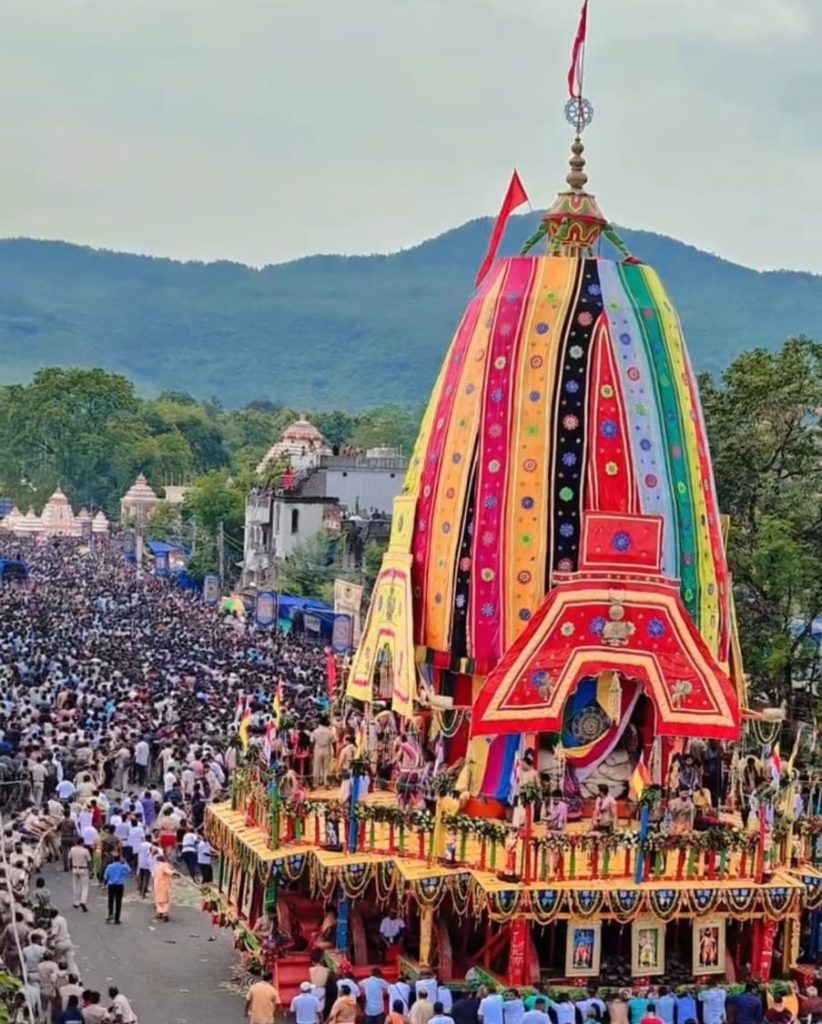
Kendujhar: The annual Rath Yatra at Sri Baladevjew temple in Kendujhar is distinguished not only by what is regarded as the world’s tallest wooden chariot, but also by its centuries-old Tantric tradition of worshipping the Trinity.
The ritual influence of Tantra is most visibly reflected in the blood-red idol of Devi Subhadra, unlike the customary yellow depiction seen at the Srimandir in Puri and elsewhere, making the festival one of Odisha’s most distinctive religious observances.
The Sri Baladevjew Temple was built in 1661 by King Laxminarayan Bhanja, who also instituted the annual Rath Yatra.
Although Lord Baladevjew is the presiding deity, the sibling deities – Lord Balabhadra, Devi Subhadra and Lord Jagannath – travel together in a single chariot, known as Nandighosh, during the Gundicha Yatra.
Standing about 72 ft high and 45 ft in width, the 16-wheeled wooden chariot is believed to be the tallest of its kind in the world.
Construction begins on the auspicious occasion of Akshaya Tritiya and concludes on Naba Jau bana Darshan.
According to chief carpenter Nilamani Maharana, known as the Ratha Maharana, nearly 3,000 quintals of timber of different varieties are used to build the massive structure.
Lakhs of devotees from Kendujhar and neighbouring districts gather for the nine-day festival to witness the deities atop the towering chariot and participate in pulling it to the Gundicha Temple.
Also Read : SC allows release of animated film ‘Mahaprabhu Jagannath’ post ‘Lord Jagannath Yatra’
The temple’s distinctive tradition is rooted in the region’s earlier religious his tory.
Before the Baladevjew temple was built, Lord Jagannath was worshipped at Sidha Matha as Siddha Jagannath, about 2 km from the old town, where the shrine was known as a Buddhist site.
Local tradition holds that followers of the Hinayana sect, who practised Tantric rituals, worshipped Jagannath there using esoteric rites, dressing the deity in black and identifying Buddha as an incarnation of Jagannath.
When King Laxminarayan Bhanja established Baladev jew Temple in 1661, he brought the idol of Baladev jew from Baitarani River and transferred Lord Jagannath from Siddha Matha.
He then installed Devi Subhadra alongside the two deities, following the tradition followed in Puri Sri Mandir.
According to temple lore, however, the region’s strong Tantric influence transformed Subhadra’s complexion from yellow to blood red, a feature that has been preserved ever since and remains the temple’s defining iconographic characteristic.
The Rath Yatra also reflects Kendujhar’s tribal heritage. The Bhuyan community, historically associated with the former Royal family, continues to play a ceremonial role in the festival.
Members of the tribe traditionally present a rope woven from siali creepers for pulling the chariot, preserving a custom that dates back centuries. During the festival, tribal communities from the surrounding hills and forests gather along ‘Bada Danda’ (Grand Road), where they perform traditional songs and dances day and night in devotion to Lord Baladevjew.
They also sell forest produce, including fruits, vegetables and nuts, turning the festival into both a major religious celebration and an important cultural and economic gathering for the region.