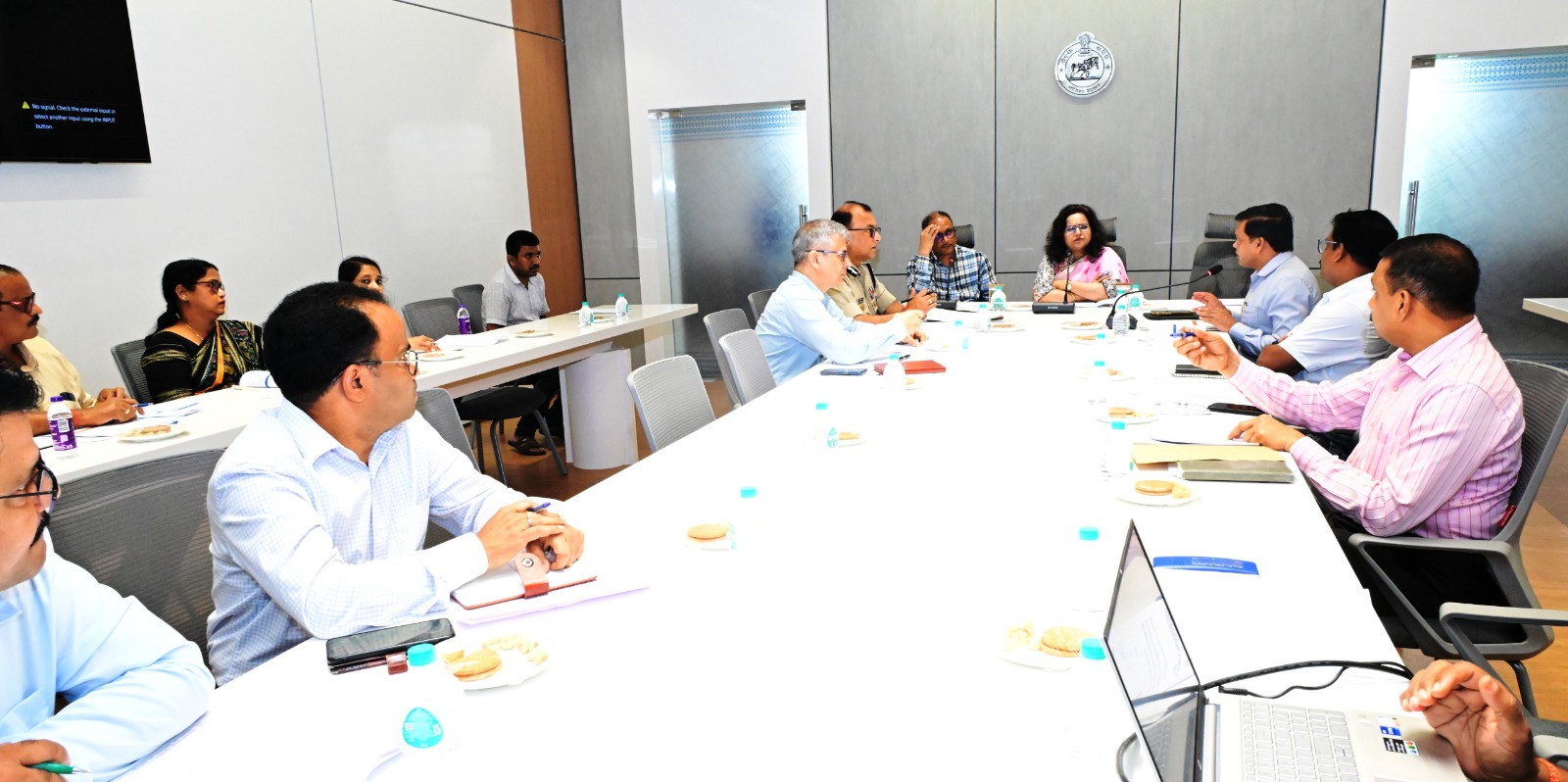
Bhubaneswar: The State Executive Committee (SEC) on Disaster Management, chaired by Chief Secretary Anu Garg, Thursday approved a series of disaster preparedness and climate resilience measures for 2026-27, including a Rs 1.77-crore project to mitigate the impact of extreme heat in Bhubaneswar and Kataka.
The heat mitigation project envisages construction of multipurpose rest areas, installation of vetiver cooling mats at bus stops, reflective roof painting in Salia Sahi, cooling facilities at the Netaji Bus Terminal in Kataka, and augmentation of public drinking water infrastructure.


The committee also earmarked an outlay of Rs 2,147 crore for disaster management, comprising Rs 1,718 crore under the State Disaster Response Fund (SDRF) and Rs 429 crore under the State Disaster Mitigation Fund (SDMF).
It was informed that Rs 1,064.48 crore has already been spent during the current financial year, while 92.93 per cent of utilisation certificates for funds released to departments and districts have been received.
Special Relief Commissioner (SRC) and OSDMA Managing Director Rajesh Prabhakar Patil outlined the committee’s role in disaster planning, preparedness, rapid response, inter-departmental coordination, damage assessment, and implementation of the State Disaster Management Plan.
The committee also discussed a major proposal to the National Disaster Management Authority (NDMA) aimed at tackling urban flooding and waterlogging in Bhubaneswar.
The Rs 222.20-crore project, comprising Rs 200 crore in Central assistance and a Rs 22.20-crore state contribution, envisages strengthening stormwater drainage, restoring and interlinking lakes, promoting rainwater harvesting and water security, and establishing early warning systems.
It also includes urban flood risk assessment and capacity-building programmes.
The meeting also reviewed proposals to strengthen disaster response infrastructure, including forest fire mitigation, modernisation of communication systems for the Odisha Disaster Rapid Action Force (ODRAF) and Fire Services, fire safety training and capaci ty building.
The plan includes procurement of HF and VHF communication sets, VSAT terminals and satellite phones to improve emergency communications.
To bolster grassroots disaster preparedness, the committee approved the formation of village-level disaster management volunteer task forces in 3,000 villages without cyclone shelters.
The volunteers will be trained in early warning dissemination, search and rescue, first aid, shelter management, water and sanitation, relief distribution, and psychosocial support.
The SEC also stressed intensifying awareness campaigns to reduce deaths from lightning, snakebites, forest fires and extreme heat.
The campaign will use mass media, posters, pamphlets, street plays, educational institutions and community outreach involving ASHA workers, Anganwadi workers, farmers and voluntary organisations.
Emphasising technology-driven disaster management, OSDMA proposed strengthening disaster-related IT systems, data management and coordination mechanisms to enable faster and more effective emergency response.
The meeting was attended by Development Commissioner and Additional Chief Secretary Deoranjan Kumar Singh and senior officials from various departments, while Director General of Police YB Khurania and Director General of Fire Services Sudhanshu Sadangi joined virtually.